
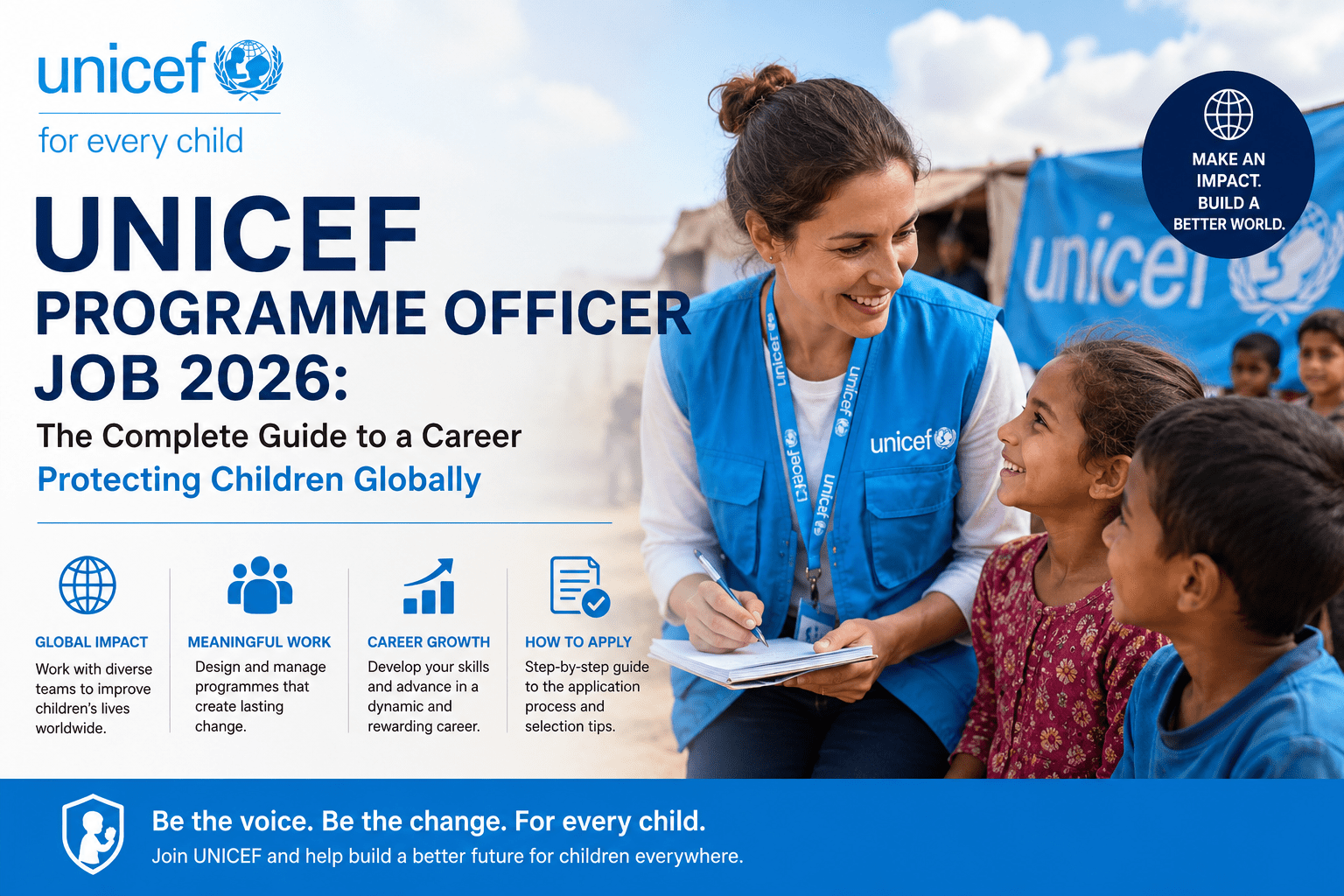
A UNICEF Programme Officer job sits at the intersection of policy, advocacy, and direct humanitarian impact in a way that very few careers can match. The United Nations Children’s Fund — headquartered in New York and operating programmes in over 190 countries — is one of the most recognisable and respected organisations in global development. If your professional background is in child protection, education, nutrition, health, or social policy, and you want to apply it at a scale that genuinely shapes the lives of millions of children, understanding how to navigate UNICEF’s hiring process in 2026 is an investment worth making right now.
For more jobs visit : Noukri Point
This guide cuts through the noise. What does a UNICEF Programme Officer actually do day to day? How does the grade system work and which level should you be targeting? What is the compensation package realistically worth? And what does a competitive application actually look like? Let us work through all of it.
What Is a UNICEF Programme Officer and What Do They Actually Do?
The title “UNICEF Programme Officer” covers a wide range of professional functions, but all of them share a common purpose: designing, managing, monitoring, and evaluating programmes that protect and improve the lives of children. Unlike purely policy-facing roles, a UNICEF Programme Officer is typically responsible for the full programme cycle — from situation analysis and strategy design through implementation, reporting, and lessons learned.
UNICEF operates through a network of regional offices covering West and Central Africa, Eastern and Southern Africa, the Middle East and North Africa, South Asia, East Asia and Pacific, Latin America and the Caribbean, and Europe and Central Asia, alongside its New York headquarters. Country offices, embedded within national governments and local partners, are where the majority of programme delivery actually happens — and where many UNICEF Programme Officers spend the bulk of their careers.
What makes this work genuinely distinctive is the breadth of the mandate. UNICEF’s programmes span early childhood development, primary education, child protection and safeguarding, adolescent health, nutrition, water and sanitation, emergency response, and climate resilience. No two UNICEF Programme Officer roles are exactly alike, which is part of what makes the organisation so attractive to professionals who want a long-term career that keeps evolving.
UNICEF Programme Officer Job Areas: Where Can You Work?
UNICEF’s programme portfolio is one of the most diverse in the UN system. Current hiring areas across UNICEF’s thematic divisions include:
Child Protection
UNICEF Programme Officers in child protection work to prevent and respond to violence, abuse, exploitation, and neglect of children. This includes strengthening national child protection systems, supporting legislative reform, working with justice sector partners on juvenile justice, and delivering community-based protection programmes in both development and humanitarian contexts.
Education in Emergencies and Development
Whether working in a stable development context or in a conflict-affected setting, UNICEF Programme Officers in education focus on expanding access to quality learning. This means everything from school construction and teacher training to distance learning systems and accelerated education programmes for children who have missed years of schooling due to conflict or displacement.
Nutrition and Early Childhood Development
UNICEF is the world’s largest procurer of therapeutic food for children suffering from acute malnutrition. Programme Officers in nutrition design and manage interventions targeting stunting, wasting, and micronutrient deficiencies — particularly in Sub-Saharan Africa and South Asia. Early childhood development roles focus on the critical 0–5 age window, integrating nutrition, stimulation, and care interventions into a coherent package.
Social Policy and Inclusion
UNICEF Programme Officers working in social policy support national governments in designing social protection systems — cash transfers, child grants, school feeding programmes — that reach the most marginalised children. This area has grown significantly as UNICEF has deepened its engagement with domestic resource mobilisation and public finance reform.
Understanding UNICEF Grade Levels: What P3 and P4 Mean for Your Career
Like all UN system agencies, UNICEF uses the ICSC common salary scale, with Professional grades running from P1 to P5. The most frequently advertised UNICEF Programme Officer positions sit at P3 and P4, though P5 and National Officer (NO) positions are also common in country offices.
- P1/P2: Entry-level professionals, primarily accessed through the JPO scheme or Young Professional Programme. Highly competitive and typically require sponsorship from a government donor
- P3: Mid-career professional; typically requires 5+ years of experience; manages specific programme components and contributes to strategic planning
- P4: Senior professional; typically 7–10+ years; leads a thematic area or manages a team; may serve as a Deputy Representative in smaller country offices
- P5: Senior manager or Chief of Section; leads a programme division and represents UNICEF in interagency or government forums
It is worth noting that UNICEF also employs a significant number of National Officers (NOA through NOC grades) in country offices. These positions are open only to nationals of the country concerned, follow national salary scales, and represent an excellent entry point for building a UN career from within your home country.
UNICEF Programme Officer Salary and Benefits in 2026
UNICEF follows the same UN common salary scales as WHO, UNDP, and other UN agencies — meaning the figures are publicly available through the ICSC and are consistent across the system. Here is what the compensation package looks like in practice.
At the P3 level, UNICEF Programme Officer base salaries typically range from approximately $62,000 to $81,000 USD annually before post adjustment. At P4, the base range rises to approximately $77,000 to $100,000 USD per year. Post adjustment — the location-based multiplier that accounts for cost of living differences between duty stations — can add significantly to this figure, particularly in high-cost cities. In New York, post adjustment can push total compensation well above the base. In lower-cost duty stations in Sub-Saharan Africa or South Asia, the multiplier is smaller, but expenses are also considerably lower.
| Detail | Information |
|---|---|
| Organization | United Nations Children’s Fund (UNICEF) |
| Role Category | Programme Officer (P3 / P4 Professional Grade) |
| Headquarters | New York, USA (+ Regional/Country Offices worldwide) |
| P3 Base Salary | ~$62,000 – $81,000 USD/year (before post adjustment) |
| P4 Base Salary | ~$77,000 – $100,000 USD/year (before post adjustment) |
| Tax Status | Generally tax-exempt in most countries |
| Contract Types | Fixed-Term, Temporary Appointment, Consultancy |
| Apply At | Official site |
The UNICEF benefits package for internationally recruited staff typically includes:
- Comprehensive health and dental insurance through the UN health scheme
- Pension contributions via the UN Joint Staff Pension Fund
- 30 days of annual leave per year
- Education grants for dependent children in international postings
- Home leave travel for internationally recruited staff
- Relocation grants and settling-in allowances when moving to a new duty station
- Hazard pay and rest and recuperation entitlements for hardship duty stations
- Exceptional mobility opportunities across UNICEF’s global country office network
Career Development Insight UNICEF is one of the few UN agencies where mid-career professionals can move from a thematic programme role to a country Representative position within a single organisation. The internal career ladder is genuinely navigable for those who perform well and build strong networks across regions. If long-term advancement is a priority, UNICEF’s size and geographic spread make it one of the best environments in the UN system for a full international career.
Eligibility and Qualifications for a UNICEF Programme Officer Job
Education Requirements
Most UNICEF Programme Officer vacancies at P3 level and above require an advanced university degree — a Master’s or equivalent — in social sciences, education, international development, public health, economics, or a related field. For some specialist roles, a first-level degree combined with substantial qualifying experience may be considered, but this is not the default expectation.
Professional Experience
For P3 UNICEF Programme Officer positions, candidates typically need a minimum of five years of progressively responsible professional experience in programme planning, management, monitoring, and evaluation in an international development or humanitarian context. Field experience — particularly in low- or middle-income country settings — is consistently weighted heavily in UNICEF’s screening. Candidates who can demonstrate experience in both development and humanitarian response contexts have a distinct advantage.
Language Requirements
Fluency in English is required for most UNICEF positions. Depending on the duty station and region, French, Spanish, or Arabic may be required or strongly desirable. For West and Central Africa roles, French is typically essential. For Latin America positions, Spanish is standard. Bilingual or multilingual candidates are consistently more competitive in UNICEF’s international recruitment.
Core Competencies UNICEF Looks For
- Demonstrated experience in programme cycle management — design, implementation, monitoring, evaluation, and reporting
- Strong capacity for evidence-based analysis and policy advocacy
- Ability to build and manage partnerships with government counterparts, NGOs, and donors
- Cultural sensitivity and effectiveness in cross-cultural working environments
- Commitment to UNICEF’s core values: care, respect, integrity, trust, accountability, and sustainability
How to Apply for a UNICEF Programme Officer Job: Step by Step
UNICEF recruits through the UN Secretariat’s Inspira platform — the same system used by most UN agencies. Understanding the platform and the process in advance will give your application a real edge.
- Register on the Inspira platform Go to official site and follow the link to the Inspira portal. Create a complete profile — this is your universal UN application profile and can be used across multiple UN agencies.
- Search and filter UNICEF vacancies Filter by category (Programme), grade level (P3, P4), duty station, and thematic area. Read each vacancy announcement carefully — they contain specific outputs and competencies that your application must address directly. Do not apply for roles where your experience does not clearly match the stated requirements.
- Complete your Inspira profile in full Inspira generates a standardised profile that substitutes for a traditional CV in the first screening stage. Every field matters. Quantify your achievements, use the vocabulary from the vacancy announcement, and ensure your employment history demonstrates progressive responsibility.
- Write a targeted cover letter Your cover letter should address two or three of the key competencies listed in the vacancy with specific, evidence-based examples from your career. Structure each example using the STAR method: Situation, Task, Action, Result. Avoid generic motivation statements — screeners read thousands of applications and can spot them immediately.
- Request your references in advance UNICEF typically requires two or three professional references, including at least one from a direct supervisor. Alert your references before you apply — response time matters, and delayed references can cost you a role even after successful interview.
- Prepare for a structured competency-based interview UNICEF interviews are highly structured. You will typically face a panel of three to four interviewers using standardised questions. Expect detailed scenario-based and behavioural questions mapped to the competencies in the vacancy. Prepare a full set of STAR examples — at least two per competency — and practice delivering them clearly and concisely within two to three minutes each.
Frequently Asked Questions About UNICEF Programme Officer Jobs
How do I apply for a UNICEF Programme Officer job in 2026?
Visit official site and register on the Inspira platform. Search for current P-grade vacancies, select roles that match your background, and submit a complete profile and cover letter before the vacancy closing date.
What is the salary for a UNICEF Programme Officer in 2026?
At the P3 level, base salaries typically range from approximately $62,000 to $81,000 USD annually before post adjustment. At P4, the range is roughly $77,000 to $100,000 USD. Post adjustment and tax-exempt status significantly increase the real value of the compensation package.
Do I need a degree in child development to work as a UNICEF Programme Officer?
No. UNICEF Programme Officer vacancies accept candidates from a wide range of academic backgrounds, including international development, public health, social policy, economics, education, and humanitarian affairs. The specific degree requirement is stated in each vacancy announcement and varies by thematic area.
Can candidates from Pakistan and Africa apply for UNICEF Programme Officer jobs?
Absolutely. UNICEF actively recruits from underrepresented member states, and both South Asia and Sub-Saharan Africa are regions where UNICEF prioritises diversity in its international professional staff. Candidates from these regions are strongly encouraged to apply, and UNICEF’s country office network in both regions provides additional pathways through National Officer positions.