
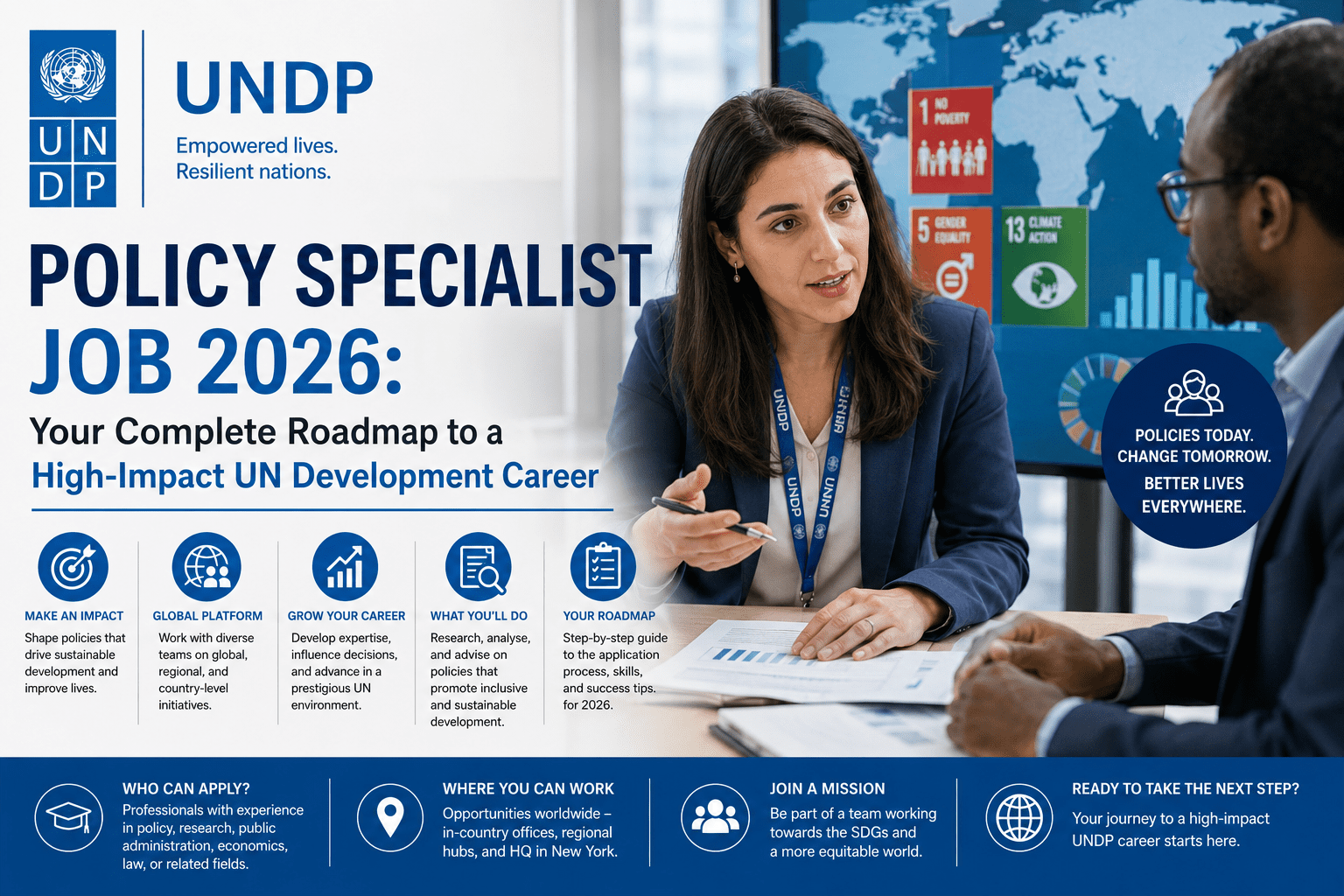
A UNDP Policy Specialist job is one of the most intellectually demanding and consequential careers available in the international development sector. The United Nations Development Programme — headquartered in New York and active in 170 countries — is the UN’s flagship development agency, working alongside governments to eradicate poverty, reduce inequality, and build resilience against climate change. If your background is in economics, governance, climate policy, or public administration, and you want to deploy that expertise in ways that actually reshape national trajectories, understanding how UNDP hires policy professionals in 2026 is the place to start.
For more jobs visit : Noukri Point
This is a detailed guide — not a surface-level overview. We will cover what UNDP Policy Specialists actually do, how the grading system works, what the salary and benefits package genuinely looks like, what qualifications are required, and how to build an application that gets past UNDP’s competitive screening process. Let us dig in.
What Is a UNDP Policy Specialist and What Do They Actually Do?
The title covers a lot of ground. At its core, a UNDP Policy Specialist is a senior technical professional who provides expert advice, analytical capacity, and policy guidance to national governments, UN country teams, and UNDP’s own programme units. Unlike programme officers who focus heavily on project management and delivery, Policy Specialists are primarily knowledge-brokers — they translate evidence into actionable recommendations and help governments design and implement better public policy.
UNDP Policy Specialists work across all three of the organisation’s main strategic pillars: eradicating poverty and reducing inequalities; accelerating structural transformations for sustainable development; and building resilience to crises and shocks. In practice, this means you might find a UNDP Policy Specialist advising a finance ministry on public debt management in one country, supporting a climate adaptation strategy in another, or designing a civic engagement programme in a post-conflict setting.
The work is headquartered in New York but is fundamentally field-oriented. UNDP’s country offices — embedded within national governments and serving as the backbone of the UN system’s development coordination function in each country — are where most Policy Specialist positions are actually based. Regional bureaux in Addis Ababa, Bangkok, Panama, Amman, and Istanbul provide technical backstopping to country offices within their regions.
UNDP Policy Specialist Job Areas | Where Can You Work?
UNDP’s thematic portfolio is unusually broad for a single development organisation. Current areas where Policy Specialist vacancies are most frequently advertised include:
Governance and Rule of Law
UNDP Policy Specialists in governance support national partners in strengthening democratic institutions, improving public administration efficiency, advancing anti-corruption measures, and building inclusive political participation. This is one of UNDP’s oldest and most active programme areas, with significant presence in fragile and post-conflict states.
Climate Change, Energy, and Environment
UNDP is the implementing agency for a significant share of Global Environment Facility and Green Climate Fund projects globally. Policy Specialists in this area advise governments on nationally determined contributions under the Paris Agreement, design nature-based solutions for climate adaptation, and support energy transition strategies in developing economies. This is currently one of UNDP’s fastest-growing hiring areas.
Inclusive Growth and Poverty Reduction
UNDP Policy Specialists working in poverty and inclusive growth conduct national human development assessments, advise on social protection system design, support domestic resource mobilisation strategies, and contribute to the production of national and regional Human Development Reports. This area sits at the analytical heart of what UNDP does.
Crisis Response and Resilience
UNDP plays a unique role in the humanitarian-development-peace nexus — supporting recovery and stabilisation in crisis-affected settings while laying the groundwork for longer-term development. Policy Specialists in this area work at the intersection of conflict analysis, post-crisis needs assessment, and early recovery programme design. Experience in fragile or conflict-affected settings is a significant differentiator for these roles.
Understanding UNDP Grade Levels: What P3 and P4 Mean for Your Career
UNDP uses the same UN common salary system as other UN agencies, with Professional grades running from P1 to P5 and Director grades at D1 and D2. The most commonly advertised UNDP Policy Specialist positions fall at the P3 and P4 levels, with some P5 openings for senior specialists who lead thematic clusters or serve as technical advisors to senior government officials.
- P1/P2: Entry professional level; accessed primarily through the Junior Professional Officer scheme or specific entry-level programmes. Rare for direct Policy Specialist recruitment
- P3: Mid-career specialist with 5+ years of relevant professional experience; provides technical inputs to policy processes and manages specific components of policy advisory assignments
- P4: Senior specialist with 7–10+ years; leads policy advisory workstreams, manages relationships with senior government counterparts, and often supervises junior team members
- P5: Principal technical expert; typically serves as Chief Technical Advisor or leads a major thematic portfolio across a region or globally
UNDP also employs significant numbers of National Officer (NOA–NOC) and Service Contract staff in its country offices. National Officer positions are open only to host country nationals, follow national salary scales, and represent a viable entry pathway for professionals looking to build a UN career from their home country.
UNDP Policy Specialist Salary and Benefits in 2026
UNDP follows the UN common system salary scales set by the ICSC, meaning the compensation framework is transparent and publicly verifiable. Here is an honest breakdown of what the package looks like at the P3 and P4 levels.
At the P3 level, base salaries for a UNDP Policy Specialist typically range from approximately $62,000 to $81,000 USD annually before post adjustment. At the P4 level, the base range rises to approximately $77,000 to $100,000 USD per year. Post adjustment — the location multiplier that accounts for cost of living differences — adds substantially in high-cost locations. In New York, for example, total compensation can reach significantly higher levels than the base figure alone suggests. In field duty stations, the base is the dominant component, but expenses in many developing country postings are considerably lower.
| Detail | Information |
|---|---|
| Organization | United Nations Development Programme (UNDP) |
| Role Category | Policy Specialist (P3 / P4 Professional Grade) |
| Headquarters | New York, USA (+ Regional Bureaux and Country Offices worldwide) |
| P3 Base Salary | ~$62,000 – $81,000 USD/year (before post adjustment) |
| P4 Base Salary | ~$77,000 – $100,000 USD/year (before post adjustment) |
| Tax Status | Generally tax-exempt in most countries |
| Contract Types | Fixed-Term Appointment, Temporary Appointment, Individual Consultancy |
| Apply At | official site |
The standard UNDP benefits package for internationally recruited staff includes:
- Health and dental insurance through the UN health insurance scheme
- Pension contributions through the UN Joint Staff Pension Fund
- 30 working days of annual leave per year
- Education grants for dependent children in international postings
- Home leave travel every two years for internationally recruited staff
- Settling-in grant and relocation assistance on appointment and transfer
- Hazard pay, rest and recuperation breaks, and security support for hardship postings
- Access to UNDP’s exceptional mobility culture — frequent rotation between country offices is expected and supported
Career Development Insight UNDP is widely regarded as one of the best development organisations for professionals who value intellectual breadth. Because UNDP works across governance, climate, poverty, and crisis, a Policy Specialist career at UNDP rarely stays narrow. Over a 15-year career, it is entirely possible to work across four or five thematic areas and a dozen country contexts. If depth in a single field is your priority, a more specialised agency might suit you better. But if you are drawn to complexity and want to keep growing intellectually across your career, UNDP is genuinely exceptional.
Eligibility and Qualifications for a UNDP Policy Specialist Job
Education Requirements
UNDP Policy Specialist positions at P3 level and above require an advanced university degree — typically a Master’s or PhD — in economics, international development, political science, public policy, social science, environmental science, or a closely related field. Some technical vacancies in areas such as energy systems or environmental finance may additionally require specific technical qualifications in those domains.
Professional Experience
For P3 UNDP Policy Specialist positions, a minimum of five years of progressively responsible professional experience in policy analysis, advisory services, or programme management in an international development context is standard. For P4, seven or more years is typically required. Practical experience in low- or middle-income country contexts — particularly field-based experience — is weighted heavily in UNDP’s competitive selection processes and often determines who makes the shortlist from an otherwise qualified pool.
Language Requirements
English is the primary working language for most UNDP Policy Specialist positions at headquarters and in regional bureaux. Country office roles frequently require proficiency in the relevant regional language — French for francophone Africa, Arabic for the Arab States region, Spanish for Latin America. Multilingual candidates are consistently advantaged in UNDP’s global recruitment.
Core Competencies UNDP Looks For
- Advanced technical expertise in at least one of UNDP’s core thematic areas
- Strong policy analysis and written communication skills — UNDP Policy Specialists produce reports, briefings, and advisory notes that reach heads of government
- Ability to translate complex evidence into actionable policy recommendations for non-specialist audiences
- Experience building credible relationships with senior government counterparts
- Adaptability to high-pressure environments and culturally diverse, politically complex settings
How to Apply for a UNDP Policy Specialist Job: Step by Step
UNDP manages its own recruitment portal independently — jobs.undp.org — rather than using the UN Secretariat’s Inspira system. Understanding this platform is the first practical step.
- Register on jobs.undp.org Go to official site and create a complete candidate profile. Set up a job alert filtered by category (Policy / Advisory), grade level (P3, P4), and your preferred region or thematic area so you are notified when matching vacancies open.
- Read each vacancy announcement thoroughly UNDP vacancy announcements contain specific output lists, competency frameworks, and mandatory vs. desirable requirements. Before applying, map your experience honestly against each requirement. Applying for roles where you do not meet the minimum requirements wastes time and damages your credibility with repeated HR reviewers.
- Build a compelling online profile UNDP’s system generates a standardised profile, but your cover letter is where differentiation happens. Your profile should be comprehensive, chronological, and quantified — use numbers wherever possible to demonstrate the scale and impact of your work.
- Write a policy-focused cover letter Unlike a standard letter of motivation, a UNDP cover letter for a Policy Specialist role should demonstrate substantive expertise. Open with a direct statement of what policy challenge you specialise in solving, then back it with evidence. Address two or three competencies from the vacancy announcement explicitly, using the STAR framework.
- Prepare a writing sample if requested Some UNDP Policy Specialist vacancies request a writing sample — a policy brief, research paper, or advisory note. Select a sample that is directly relevant to the vacancy’s thematic area and that demonstrates your analytical depth clearly. Quality matters far more than length.
- Prepare for a technical and competency-based interview UNDP shortlisting interviews for Policy Specialist roles typically combine technical questions — testing your substantive knowledge of the relevant policy area — with behavioural competency questions using the STAR method. Prepare structured examples for each competency and be ready to discuss recent policy developments in your field with depth and confidence.
Frequently Asked Questions About UNDP Policy Specialist Jobs
How do I apply for a UNDP Policy Specialist job in 2026?
Visit official site, create a candidate profile, search for current P-grade vacancies matching your thematic area and experience level, and submit a complete application — including a tailored cover letter and any requested writing sample — before the closing date.
What is the salary for a UNDP Policy Specialist in 2026?
At the P3 level, base salaries typically range from approximately $62,000 to $81,000 USD annually before post adjustment. At P4, the base range is roughly $77,000 to $100,000 USD. Post adjustment and tax-exempt status in most countries significantly increase the real value of the compensation package.
What degree do I need for a UNDP Policy Specialist position?
Most positions require an advanced degree (Master’s or PhD) in economics, public policy, international development, political science, or a closely related field. For technical positions in areas like climate finance or energy systems, specific technical qualifications in those domains are frequently required or strongly preferred.
Can professionals from developing countries apply for UNDP Policy Specialist roles?
Absolutely. UNDP explicitly prioritises diversity in its international professional staff and actively encourages applications from nationals of underrepresented member states, including across Africa, South Asia, Latin America, and the Arab States region. UNDP’s diversity policy means that equally qualified candidates from underrepresented nations are actively preferred in competitive processes.