
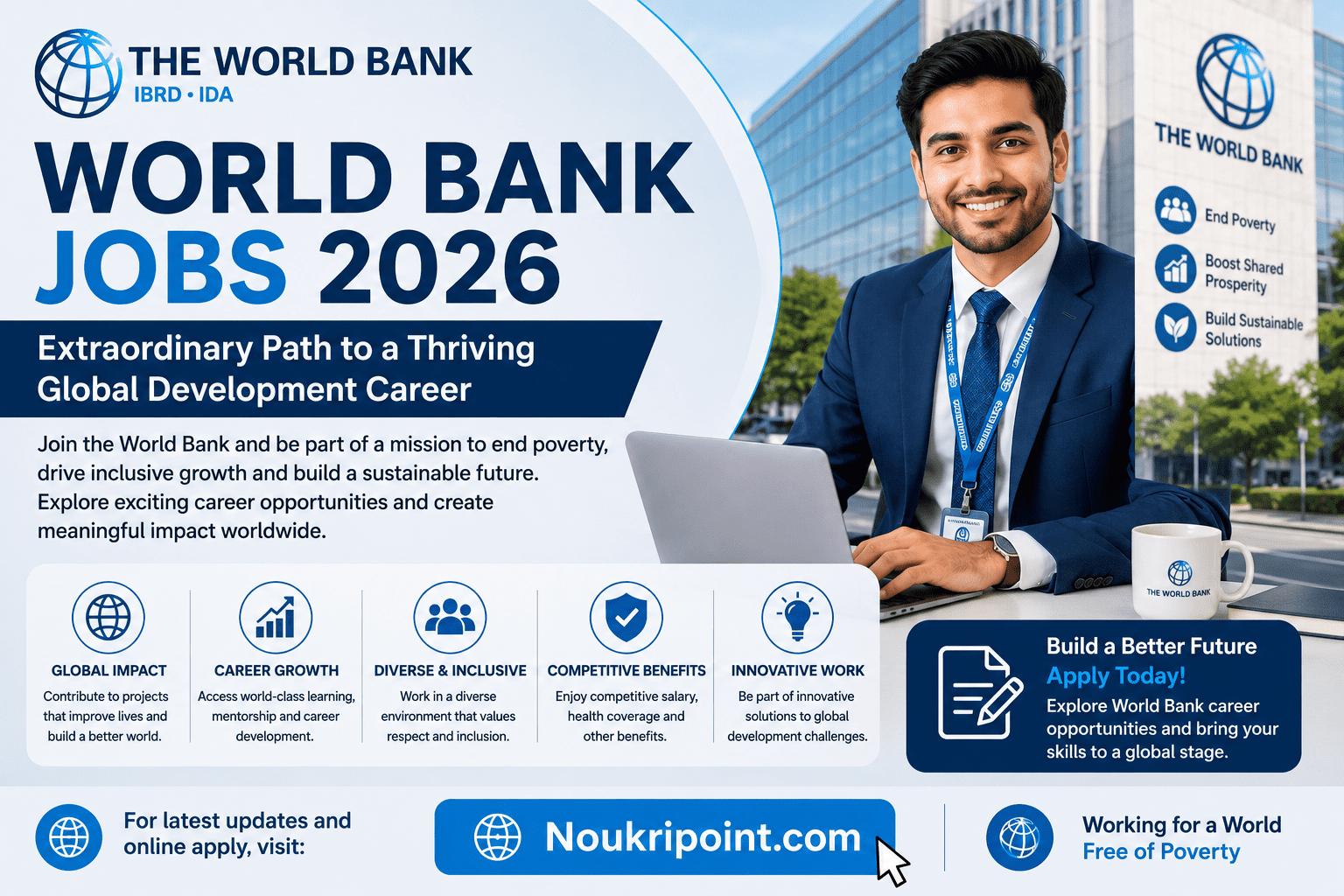
World Bank Jobs 2026 occupy a category of international career that almost every development professional aspires to at some point in their working life. The World Bank Group — headquartered in Washington D.C. and operating across more than 170 countries — is one of the world’s largest sources of financing for development projects, poverty reduction programmes, and economic reform in emerging economies. Right now in May 2026, the Bank has over 54 active vacancies ranging from entry-level analyst positions to senior specialist and manager roles across economics, infrastructure, climate, education, health, digital development, and governance. If you want to understand how the world’s most ambitious development institution actually works from the inside, this is your starting point.
For more jobs visit : Noukri Point
Let me say something plainly that most career guides avoid. The World Bank is not a place you drift into. It is an institution where the competition is genuinely fierce, the expectations are high, and the application process is structured specifically to test whether you can deliver results under pressure. Understanding that reality before you apply — and preparing accordingly — is the difference between a shortlisted candidate and one whose application disappears into the first screening filter.
What Are World Bank Jobs 2026 and What Does Working There Actually Mean?
The World Bank Group is not a single institution — it is a family of five organizations that together address different dimensions of development finance and support. The two largest are the International Bank for Reconstruction and Development (IBRD), which lends to middle-income countries, and the International Development Association (IDA), which provides concessional loans and grants to the world’s poorest nations. Together they employ over 15,000 staff across 130 country offices worldwide.
World Bank Jobs 2026 span an extraordinarily broad range of disciplines. On any given day, the Bank’s staff includes economists advising governments on fiscal reform, engineers overseeing infrastructure projects in sub-Saharan Africa, data scientists building poverty measurement systems, lawyers structuring sovereign debt agreements, and communications specialists translating complex development evidence into public policy narratives. The breadth of the institution is one of its most attractive features for professionals who want a career that never stops challenging them intellectually.
Working at the World Bank also means operating inside the development world’s most extensive professional network. Colleagues include some of the most credentialed economists, engineers, and policy specialists on the planet. The exposure that comes from collaborating in that environment — even in a junior role — accelerates professional development in ways that few employers outside the multilateral system can match.
World Bank Jobs 2026 | Currently Open Positions and Functional Areas
As of May 2026, the World Bank has 54-plus active vacancies listed across its careers portal. New openings are posted continuously — the Bank opens each vacancy for approximately two weeks before closing applications. Here is a breakdown of the key functional areas currently hiring:
Economics and Development Research
- Research Assistant (DIME — Development Impact): Supporting data acquisition, processing, cleaning, and analysis for impact evaluation research | deadline April 29, 2026 | strong quantitative background required
- Economist (GF-D to GF-F): Country-level macroeconomic analysis, policy advisory, and public expenditure review work across multiple regions
- Senior Economist (GF-G): Leading analytical programmes and engaging directly with government counterparts at Finance Ministry and Central Bank level
Infrastructure, Climate and Environment
- Infrastructure Specialist: Transport, energy, and urban development project oversight across South Asia, East Africa, and Latin America
- Climate Change Specialist: Working on green finance instruments, adaptation project design, and climate-resilient infrastructure programmes
- Environmental and Social Specialist: Ensuring Bank-financed projects comply with ESF (Environmental and Social Framework) standards
Digital Development and Technology
- Digital Development Specialist: Advising governments on digital infrastructure, broadband policy, and e-government platforms
- Data Scientist / Analytics Specialist: Building data pipelines and predictive models for poverty targeting, results monitoring, and development programme evaluation
Operations and Country Management
- Operations Analyst / Associate: Supporting Country Management Units with portfolio monitoring, client coordination, and operational reporting
- Program Assistant: Administrative and logistics support for regional office teams across multiple duty stations
| Detail | Information |
|---|---|
| Organization | World Bank Group | Washington D.C., USA |
| Active Vacancies (May 2026) | 54+ positions globally |
| Salary Scale | GF (Global Fixed) | GF-D to GF-I |
| GF-D/E Salary Range | ~$84,000 to $120,000 USD/year |
| GF-F/G Salary Range | ~$120,000 to $220,000 USD/year |
| Application Window | Typically 2 weeks per vacancy |
World Bank Salary and Benefits in 2026
One of the most compelling aspects of World Bank Jobs 2026 is the compensation structure. The Bank uses its own Global Fixed (GF) pay scale — an internal system independent of both US government pay scales and the UN common system used by agencies like WHO and UNDP.
Here is a realistic picture of what different grade levels earn annually:
- GF-C (Support/Administrative): Approximately $55,000 to $75,000 USD per year
- GF-D and GF-E (Analyst/Associate): Approximately $84,000 to $120,000 USD per year
- GF-F (Specialist/Senior Associate): Approximately $120,000 to $150,000 USD per year
- GF-G (Senior Specialist/Manager): Approximately $150,000 to $220,000 USD per year
- GF-H and GF-I (Director and above): $220,000 USD and above
Beyond the headline salary, World Bank staff receive:
- Comprehensive health and dental insurance through the World Bank Medical Benefits Plan
- Generous pension through the Staff Retirement Plan
- Education benefits for dependent children of internationally recruited staff
- 30 days of annual leave per year
- Relocation and settling-in allowances for international postings
- Access to the World Bank’s extensive professional development and learning programmes
- Partial income tax exemption in many countries for internationally recruited staff
Two-Week Application Window — Act Fast World Bank Jobs 2026 vacancies are typically open for only two weeks before the application portal closes. Unlike many UN agencies that leave vacancies open for four to six weeks, the Bank moves quickly. Monitoring the careers portal weekly and applying within the first three to five days of a vacancy opening is not optional — it is the practical reality of competing successfully for these roles.
Eligibility Requirements for World Bank Jobs 2026
Education
For most professional-grade World Bank Jobs 2026, a Master’s degree or PhD in a relevant discipline is either required or strongly preferred. Relevant fields include Economics, Finance, Public Policy, International Development, Engineering, Environmental Science, Law, Computer Science, and related disciplines. For analyst-level GF-D positions, a strong Bachelor’s degree from a top-tier university with outstanding academic performance can sometimes suffice, though postgraduate credentials are the norm at this institution.
Professional Experience
Experience requirements scale with grade level. GF-D analyst roles may accept candidates with two to four years of post-degree work experience in relevant fields. GF-F specialist positions typically require seven or more years. Senior GF-G roles expect a decade or more of progressive professional growth — including demonstrated experience engaging directly with government officials at senior levels. International experience, particularly in developing countries, carries significant weight across all categories.
Core Competencies the Bank Looks For
- Analytical depth — the Bank prizes evidence-based thinking above all other professional skills
- Client orientation — the ability to translate technical analysis into practical solutions for government counterparts
- Teamwork in multicultural settings — most World Bank projects involve teams spanning five or more nationalities
- Written communication — virtually all output at the Bank is written, and the quality bar is extremely high
- Delivering results under ambiguity — development contexts rarely offer neat, predictable operating environments
How to Apply for World Bank Jobs 2026 | Step by Step
- Create your World Bank careers profile Go to official site and register your candidate account. Set up job alerts filtered by your functional area of interest — Economics, Infrastructure, Digital, Climate — so you receive immediate notification when a matching vacancy appears.
- Read the vacancy carefully before applying Each World Bank Jobs 2026 posting contains screening questions that directly influence whether your application reaches the Selection Advisory Committee. Read every question carefully and frame your answers against the specific competencies and experience requirements listed — not against your general career history.
- Complete the screening questions with concrete evidence The Bank’s initial screening is largely automated through responses to structured questions. Vague answers are scored lower than specific, achievement-focused ones. For every question, provide a concrete example: a country, a policy, a dataset, a project — something that proves rather than claims your capability.
- Tailor your CV to World Bank’s format and language A World Bank-ready CV leads with education credentials prominently, quantifies achievements wherever possible, uses development sector terminology naturally, and demonstrates progressive responsibility over time. Generic corporate CVs do not perform well in this system — the reviewers are development professionals who notice the difference immediately.
- Prepare for the on-demand video interview or panel Shortlisted candidates face either an asynchronous on-demand video interview or a live panel interview. For on-demand formats, record in a quiet, well-lit environment with a plain background. For panel interviews, prepare structured answers using the STAR method for each competency listed in the vacancy. Some roles also require a written test, case study, or brief presentation.
- Be ready for reference and background checks The World Bank conducts thorough reference checks before issuing any Letter of Appointment. Identify three professional references — ideally supervisors or senior colleagues who can speak directly to your analytical output and delivery track record — and brief them in advance that a World Bank reference request may be coming.
Practical Strategies to Strengthen Your World Bank Application
- Your publication or analytical output record matters more than your degree name. The World Bank’s hiring teams look for evidence of thinking quality, not just credential lists. If you have published research, policy briefs, working papers, or even high-quality blog analysis on development topics, make these visible — link to them in your application wherever the system allows.
- Country-specific knowledge is a genuine differentiator for regional roles. When applying for a South Asia, Africa, or Latin America posting, candidates who demonstrate deep knowledge of the specific country’s fiscal situation, development challenges, and political economy consistently advance further than those with only generalist development backgrounds.
- The Young Professionals Program (YPP) is the Bank’s most direct entry point for early-career candidates. If you are under 32 years old with a postgraduate degree and strong academic standing, the World Bank YPP — which opens for applications each year — is specifically designed to bring talent into the institution at the entry officer level. It is fiercely competitive but worth prioritizing if you meet the age and academic criteria.
- Consultancy roles are a realistic stepping stone into staff positions. Many World Bank staff members were previously consultants or short-term contractors. A well-executed consultancy assignment builds internal credibility and creates a direct network connection to hiring managers for future staff vacancies. If a permanent role is not immediately accessible, pursue a consultancy as a strategic entry point.
- Apply within the first 48 hours of a vacancy opening. With only a two-week window and the Bank receiving hundreds of applications for popular roles, early submission puts you ahead of the majority of applicants in the automated screening queue. Do not let the perfect application be the enemy of a timely one.
Frequently Asked Questions
How do I apply for World Bank Jobs 2026?
Visit official site create your candidate profile, browse active vacancies, complete the application form and screening questions for your target role, attach your tailored CV, and submit before the two-week closing window ends. Applications are not accepted by email or post.
What salary do World Bank Jobs 2026 offer?
World Bank salaries follow the GF scale. Entry analyst roles (GF-D/E) earn approximately $84,000 to $120,000 USD per year. Specialist and senior roles (GF-F/G) earn $120,000 to $220,000 USD annually. Packages include health insurance, pension, education benefits, and relocation allowances.
Can Pakistani nationals apply for World Bank Jobs 2026?
Yes. Pakistani nationals are fully eligible. Pakistan is a member country of the World Bank Group and the Bank actively recruits from all member states. Candidates from Pakistan who meet the stated qualifications and experience requirements for any advertised vacancy are encouraged to apply.
What is the World Bank hiring process?
The Bank opens vacancies for two weeks, screens applications using structured questions, forms a shortlist of three to five candidates through a Selection Advisory Committee, conducts an on-demand video or panel interview, and may include a written test or case study. After selection, reference and background checks are completed before a Letter of Appointment is issued. The full process typically takes six to twelve weeks after vacancy closure.