
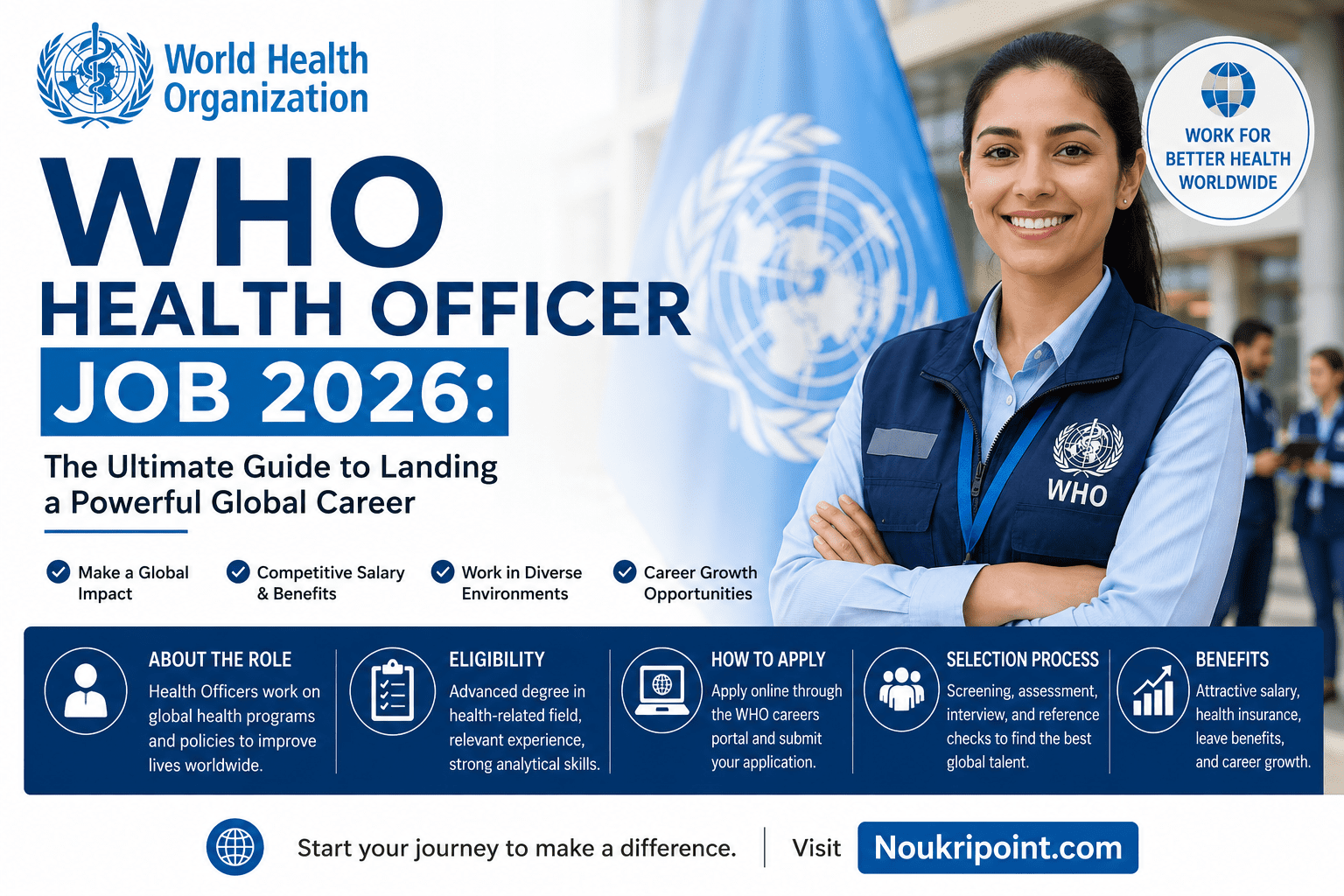
A WHO Health Officer job is one of the most respected career paths in international public health. The World Health Organization — headquartered in Geneva and operating in every corner of the globe — is continuously hiring professionals across epidemiology, emergency response, health policy, and program management. If you have a background in public health, medicine, or a related field and you genuinely want to make a difference at a global scale, understanding how to navigate the WHO recruitment process in 2026 is one of the most important things you can do for your career right now.
For more jobs visit : Noukri Point
I want to give you a genuinely useful picture of what this career path looks like — not a vague overview you could find anywhere, but the real specifics: what WHO Health Officers actually do, what the different grade levels mean, what the salary and benefits look like, and how to approach your application in a way that actually gives you a fighting chance. Let us get into it.
What Is a WHO Health Officer and What Do They Actually Do?
The title “WHO Health Officer” is an umbrella term that covers a wide spectrum of professional roles within the organization. At its core, a WHO Health Officer is a technically trained professional who works to advance public health goals — whether that means responding to a disease outbreak in Central Africa, developing health policy recommendations for a Southeast Asian government, or coordinating a vaccination campaign that reaches millions of children.
The World Health Organization employs WHO Health Officers across three main tiers of operation: headquarters in Geneva, regional offices in locations like Cairo, Manila, New Delhi, and Brazzaville, and country offices embedded directly within national health ministries. Each level offers a different kind of experience, and many career professionals move between all three over the course of a long WHO career.
What unifies them all is a shared commitment to one of the most ambitious goals in human history: ensuring that every person on earth has access to the highest possible standard of health. That is not just a mission statement. It is the filter through which every WHO Health Officer views their work each day.
WHO Health Officer Job Areas | Where Can You Work?
One of the things I find most compelling about a WHO Health Officer career is the sheer variety of work available within the organization. WHO is not a single-focus agency — it operates across a vast range of technical and operational domains. Current hiring areas include:
Health Emergencies and Outbreak Response
This is perhaps the most visible area of WHO work. Health Officers in emergency response are deployed to support national authorities during disease outbreaks, natural disasters, and other public health crises. The COVID-19 pandemic brought global attention to this work, but it happens at a smaller scale dozens of times every year — from cholera outbreaks to Ebola responses to conflict-zone humanitarian health operations.
Communicable and Noncommunicable Disease Programs
WHO Health Officers in these programs develop and coordinate global strategies to tackle both infectious diseases — like tuberculosis, HIV, and malaria — and noncommunicable diseases like cancer, diabetes, and cardiovascular conditions. This work combines evidence-based policy development with practical program implementation across member states.
Health Systems Strengthening
A WHO Health Officer working in health systems focuses on helping countries build sustainable healthcare infrastructure. This includes improving primary care networks, training health workforces, strengthening pharmaceutical supply chains, and advancing universal health coverage. This area is particularly active in low- and middle-income countries.
Data, Surveillance, and Research
WHO relies heavily on data to drive its decisions. Health Officers working in surveillance and analytics manage global health information systems, track disease trends, publish the World Health Statistics reports, and support countries in building their own epidemiological monitoring capacity.
Understanding WHO Grade Levels: What P3 and P4 Mean for Your Career
If you are new to international organizations, the grading system can be confusing. Here is what you need to understand about how WHO Health Officer positions are classified.
WHO uses the United Nations common system of grades. Professional positions run from P1 (entry level) to P5 (senior professional), with D1 and D2 for directors. The most commonly recruited WHO Health Officer roles sit at the P3 and P4 levels, which represent mid-career professionals with five to ten or more years of relevant experience.
- P1/P2: Entry-level professional positions, often filled through the Junior Professional Officer (JPO) programme or young professional entry schemes
- P3: Mid-career specialist with typically 5+ years of experience; takes ownership of technical workstreams within a department
- P4: Senior technical or managerial professional with 7–10+ years; often leads a programme area or manages a small team
- P5: Senior expert or team lead, often responsible for overseeing an entire technical area or country programme
Understanding which grade you are targeting is critical for a successful WHO Health Officer job application, because the experience requirements, responsibilities, and application competencies differ significantly at each level.
WHO Health Officer Salary and Benefits in 2026
Let us talk compensation honestly, because this is where a lot of online information is either vague or outdated.
WHO Health Officer salaries follow the International Civil Service Commission (ICSC) salary scales, which are publicly available. At the P3 level, base salaries typically range from approximately $62,000 to $81,000 USD per year. At the P4 level, the base range rises to approximately $77,000 to $100,000 USD annually. These figures are before post adjustment — a location-based multiplier that can significantly increase the final take-home amount depending on your duty station.
In Geneva, for example, the post adjustment is substantial, reflecting Switzerland’s high cost of living. In lower-cost duty stations, the post adjustment is smaller. But in most countries, WHO salaries are tax-exempt — meaning the net value of these figures is considerably higher than equivalent gross salaries in the private sector.
| Detail | Information |
|---|---|
| Organization | World Health Organization (WHO) |
| Role Category | Health Officer (P3 / P4 Professional Grade) |
| Headquarters | Geneva, Switzerland (+ Regional/Country Offices) |
| P3 Base Salary | ~$62,000 – $81,000 USD/year (before post adjustment) |
| P4 Base Salary | ~$77,000 – $100,000 USD/year (before post adjustment) |
| Tax Status | Generally tax-exempt in most countries |
| Contract Types | Fixed-Term, Temporary Appointment, Consultancy |
| Apply At | who.int/careers via the Stellis platform |
Beyond salary, WHO Health Officers receive a benefits package that includes:
- Comprehensive health and dental insurance through the UN health scheme
- Pension contributions via the UN Joint Staff Pension Fund
- Generous annual leave — typically 30 days per year
- Education grants for dependent children in international postings
- Home leave travel every two years for internationally recruited staff
- Relocation assistance and settling-in grants when moving to a new duty station
- Mobility opportunities to serve at different offices across WHO’s global network
Career Development Insight One of the most undervalued benefits of a WHO Health Officer career is the professional network. Working inside WHO means you are regularly collaborating with public health experts from over 190 member states, leading academic institutions, and major NGOs. The connections you build across a WHO career are simply not replicable in any national health system role.
Eligibility and Qualifications for a WHO Health Officer Job
Education Requirements
Most WHO Health Officer positions at the P3 level and above require an advanced university degree — a Master’s or equivalent — in medicine, public health, epidemiology, health policy, or a closely related field. For some specific technical roles, a first-level university degree combined with extensive relevant experience may be considered, but this is the exception rather than the rule.
Professional Experience
Experience requirements vary by grade. For a P3 WHO Health Officer position, candidates typically need at least five years of relevant professional experience in public health, health program management, or a directly related technical field. For P4 roles, seven or more years is standard. International experience — particularly in low- or middle-income countries — is highly valued and often differentiates shortlisted candidates from the broader pool.
Language Requirements
Proficiency in at least one official UN language is required, with English being the primary working language at headquarters. For regional office positions, the relevant regional language (French for AFRO, Arabic for EMRO, Spanish for AMRO/PAHO) is often required or strongly preferred. Multilingual candidates consistently have an advantage in WHO Health Officer recruitment.
Core Competencies WHO Looks For
- Demonstrated ability to produce results and deliver on commitments under challenging conditions
- Strong communication skills across diverse cultural and institutional contexts
- Capacity to build and maintain partnerships with governments, NGOs, and academic institutions
- Sound analytical and technical judgment in public health decision-making
- Respect for diversity and a genuine commitment to the principles of global health equity
How to Apply for a WHO Health Officer Job: Step by Step
The WHO application process is thorough and structured. Understanding it in advance will save you significant time and frustration.
- Create a profile on the WHO Stellis platform All WHO Health Officer vacancies are posted and managed through Stellis — WHO’s official recruitment system. Go to WHO site and register. Once inside, you can set up job alerts so you are notified the moment a vacancy matching your profile is posted.
- Search for current P-grade vacancies Filter by grade level (P3, P4), technical area, and preferred duty station. Read every vacancy announcement carefully before applying — WHO job descriptions are detailed and contain specific competencies that your application must address directly.
- Tailor your CV to WHO’s format and language WHO values precision and evidence. Your CV should quantify achievements wherever possible, use the same terminology that appears in the vacancy announcement, and clearly demonstrate progressively increasing responsibility over your career. A generic CV will not work here.
- Write a WHO-specific cover letter Your cover letter must directly address the specific competencies listed in the vacancy. Pick two or three competencies from the list and provide concrete examples from your career that demonstrate each one. This is not the place for generic enthusiasm — it is the place for evidence.
- Complete self-assessment questions if required Some WHO Health Officer vacancies include self-assessment questions as part of the application. These are typically scenario-based and assess your technical knowledge and judgment. Answer them thoroughly — they carry significant weight in the initial screening.
- Prepare for a competency-based interview If shortlisted, you will face a structured competency-based interview. WHO interviewers use the STAR method (Situation, Task, Action, Result) to assess candidates. Prepare at least two detailed examples for each of the core competencies listed in your target vacancy.
Frequently Asked Questions About WHO Health Officer Jobs
How do I apply for a WHO Health Officer job in 2026?
Visit WHO site and register on the Stellis platform. Search for current Professional (P-grade) vacancies, select roles that match your background, and submit a tailored application with CV and cover letter before the closing date.
What is the salary for a WHO Health Officer in 2026?
At the P3 level, WHO Health Officer base salaries range from approximately $62,000 to $81,000 USD annually before post adjustment. At P4, the range is roughly $77,000 to $100,000 USD. Post adjustment and tax-exempt status significantly increase the real value of the package.
Do I need a medical degree to become a WHO Health Officer?
Not always. While many WHO Health Officer roles require medical training or an advanced degree in public health or epidemiology, others are open to professionals from health systems management, research, data analysis, or global development backgrounds. Each vacancy specifies its own educational requirements.
Can candidates from Pakistan and South Asia apply for WHO Health Officer jobs?
Absolutely. WHO actively encourages applications from nationals of underrepresented member states, and this includes Pakistan and broader South Asia. WHO’s diversity and inclusion policy specifically aims to increase representation from countries in WHO’s Eastern Mediterranean and South-East Asia regions.