
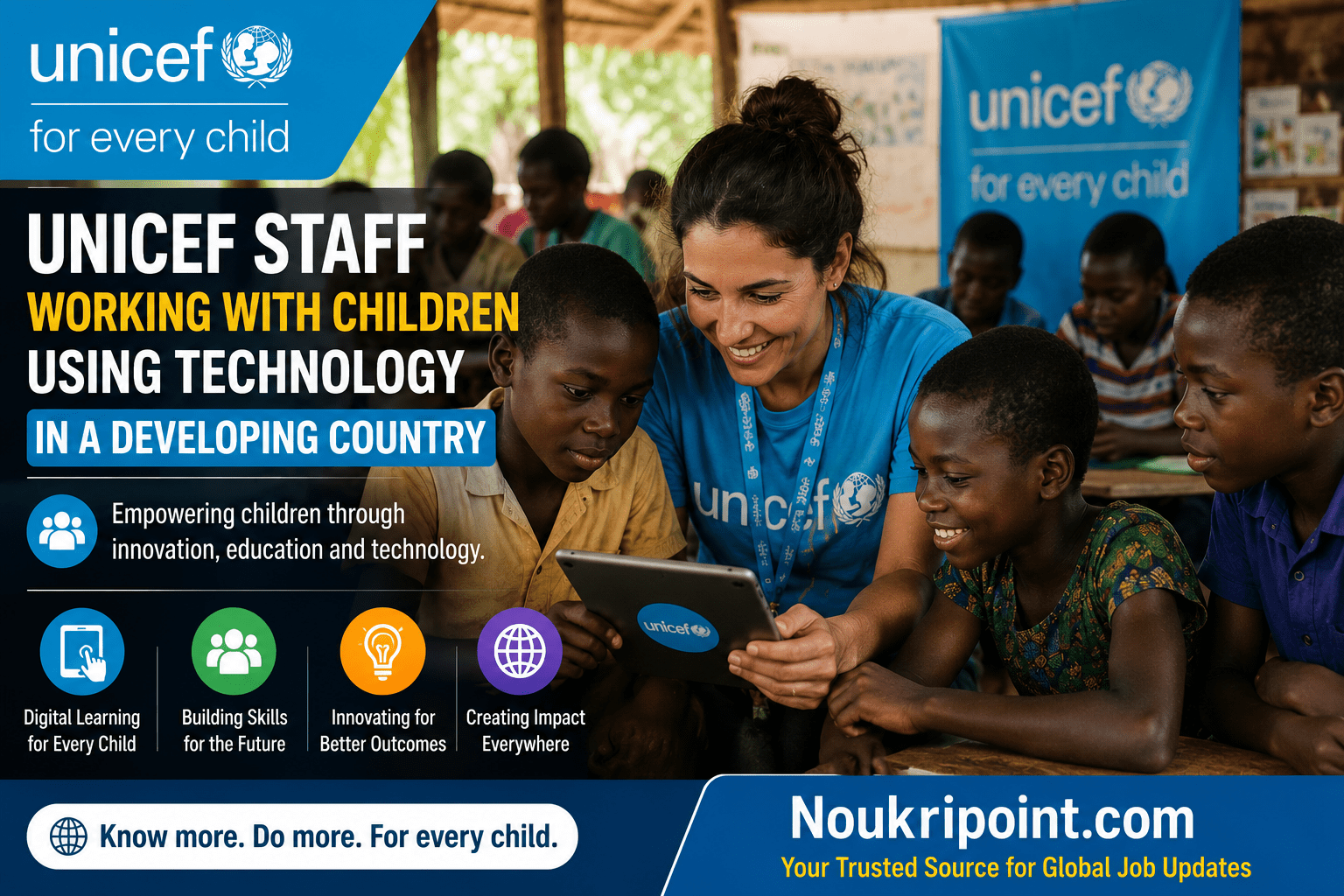
The UNICEF Innovation Specialist job that just opened up is one of those opportunities that does not come around often. UNICEF — one of the most respected international organizations in the world — is actively hiring for a P3-level Innovation Specialist through its Office of Innovation, with a firm application deadline of May 28, 2026. If you have ever dreamed of building a career that genuinely changes lives on a global scale, you need to read every word of this article before you decide whether to apply.
For more jobs visit : Noukri Point
I want to be straight with you. This is not just another job listing roundup. Having followed international development careers closely, I know how confusing UN job applications can feel — the grading systems, the competency frameworks, the P11 forms. So I am going to break everything down in plain language so you actually understand what this role is, who it is for, and how to give yourself the best shot at landing it.

What Exactly Is the UNICEF Innovation Specialist Role?
Let us start with the basics. UNICEF operates in over 190 countries and territories. Its Office of Innovation is the team responsible for identifying, testing, and scaling technology-based solutions that improve children’s lives — whether that means better vaccines, smarter education tools, or digital identity systems for refugees.
The Innovation Specialist (P3) sits at the center of this work. Specifically, this role oversees two active initiatives called SPARK and COMPASS. These are not small pilot programs. They are live operational projects that connect innovation strategy with on-the-ground delivery across multiple countries. You would be the person making sure these projects stay on track, stay aligned with UNICEF’s broader priorities, and actually deliver measurable results.
Think of it less like a traditional management job and more like being a conductor. You are not playing every instrument yourself, but you are making sure every team member — in New York, in Geneva, in Nairobi — is playing in time and in tune.
[Supporting Image Here]
Alt text: “UNICEF Office of Innovation team collaborating on global development projects”
Suggested image: Team working on innovation project in an international office setting
Key Responsibilities You Will Own in This Position
Understanding the day-to-day duties is important before you apply. Here is what the role actually involves:
- Providing strategic oversight and quality assurance for the SPARK and COMPASS programs
- Acting as the bridge between the Office of Innovation, regional offices, and country-level UNICEF teams
- Managing project timelines, deliverables, and performance benchmarks
- Facilitating cross-regional knowledge sharing so lessons from one country benefit others
- Supporting the Innovation Manager on design decisions, capacity-building, and stakeholder communications
- Ensuring coherence between program delivery and UNICEF’s global innovation strategy
What I find particularly interesting about this role is that word “coherence.” At UNICEF’s scale, it is shockingly easy for a great idea to get lost between strategy and execution. The Innovation Specialist is specifically the person who prevents that. If you have ever worked on a project where the vision at the top and the reality on the ground were completely out of sync, you already understand exactly why this job matters.
Who Should Apply: Eligibility and Requirements
Education Background
UNICEF requires an advanced university degree — that means a Master’s or equivalent — in a relevant field. This could be innovation management, international development, public administration, computer science with a humanitarian focus, or social entrepreneurship. If you have a Bachelor’s degree plus substantial additional professional experience, some UN agencies do make exceptions, but for P3 positions, a Master’s is strongly preferred.
Work Experience
This is where many candidates fall short. A P3 position at UNICEF requires a minimum of five years of progressively responsible professional experience. The word “progressively” matters here — it means your responsibilities should have grown over time, not just that you did the same job for five years.
Ideal candidates will have experience in areas such as:
- Managing multi-country innovation or technology programs
- Working with UN agencies, international NGOs, or government bodies
- Digital product development or human-centered design
- Monitoring, evaluation, and learning (MEL) in development contexts
- Coordinating across multiple teams in different time zones
Language Requirements
Fluency in English is mandatory — and I mean true fluency, not conversational. Your application, your cover letter, and any interview will all be conducted in English. Knowledge of a second UN language (French, Arabic, Spanish, Russian, or Chinese) is a real differentiator when shortlists get competitive.
Quick Job Facts at a Glance
| Detail | Information |
|---|---|
| Organization | UNICEF — Office of Innovation |
| Job Title | Innovation Specialist (P3, Temporary Appointment) |
| Location | International / Global |
| Application Deadline | May 28, 2026 at 11:55 PM UTC |
| Salary Range (Base) | Approx. $62,000 – $81,000 USD/year (before post adjustment) |
| Contract Type | Temporary Appointment (TA) |
| Apply At | jobs.unicef.org |
Salary, Benefits, and Why UN Compensation Is Different
Let me explain something that trips up a lot of first-time UN job applicants. The base salary alone does not tell the full story. At the P3 level, UNICEF follows the International Civil Service Commission (ICSC) salary scale. The base pay runs from roughly $62,000 to $81,000 USD per year — but then you add “post adjustment,” which is a cost-of-living multiplier tied to your duty station.
Depending on where you are posted, your total compensation can be significantly higher than the base figure suggests. And in most countries, UN salaries are tax-exempt, which makes the net value genuinely substantial.
Beyond salary, UNICEF staff at this level also receive:
- Comprehensive health and dental insurance
- Pension contributions through the UN Joint Staff Pension Fund
- Generous annual and sick leave entitlements
- Education grants for dependent children in international postings
- Home leave travel for internationally recruited staff
- Dependency allowances where applicable
Important Note UN salaries are pegged to location-based post adjustments. Always calculate the full package — including post adjustment and tax exemption — when comparing this role against private sector alternatives. The true compensation is almost always more competitive than the base figure implies.
How to Apply: Step-by-Step Guide for First-Time UN Applicants
If you have never applied to a UN position before, the process can feel bureaucratic and intimidating. It does not have to be. Here is exactly what you need to do, in order:
- Register on jobs.unicef.org Create your candidate profile on the official UNICEF careers portal. Make sure every section is complete — incomplete profiles are often filtered out automatically before a human ever reads them.
- Prepare your P11 form Most UN agencies require a Personal History Form (P11) in addition to a standard CV. This document captures your academic credentials, employment history, languages, and references in a standardized format. Download the latest version from the UN Secretariat website.
- Write a targeted cover letter Generic cover letters are rejected instantly. Your letter must directly address the specific competencies listed in the UNICEF job description. Use concrete examples from your career — with numbers wherever possible — that demonstrate real impact.
- Align your CV with UN competency frameworks UNICEF uses specific language around competencies like “results-based management,” “communication,” and “innovation.” Mirror this language in your CV. This is not about padding — it is about speaking the same language as the hiring panel.
- Submit at least 48 hours before the deadline The May 28, 2026 deadline is absolute. The system closes at 11:55 PM UTC and does not accept late submissions. Technical issues happen. Do not risk it — submit early.
5 Tips to Make Your Application Stand Out
Thousands of professionals apply to P3-level UNICEF positions every recruitment cycle. Here is what actually separates shortlisted candidates from everyone else:
- Quantify everything you can. “I managed a project” is weak. “I managed a $2.3M regional program across 7 countries, delivering results for 140,000 beneficiaries on time and under budget” is compelling. Numbers build credibility instantly.
- Show cross-sector experience. UNICEF loves candidates who have worked across government, NGO, and private sector environments. If you have that breadth, make it obvious on your CV and in your cover letter.
- Demonstrate genuine understanding of child rights. This is UNICEF — not a generic international organization. Candidates who clearly understand and believe in the mission stand out from those who are applying to “a UN job” generically.
- Prepare your references proactively. UNICEF contacts references during the later stages. Warn your referees now so they are not caught off guard by an email from a UN hiring panel.
- Highlight field experience. If you have worked in low- or middle-income countries — especially in humanitarian or development contexts — put that front and center. It is one of the strongest differentiators at the P3 level.
Frequently Asked Questions
What is the deadline to apply for the UNICEF Innovation Specialist job?
The application deadline is May 28, 2026 at 11:55 PM UTC. The system closes automatically at that time and does not accept late submissions under any circumstances. It is strongly recommended to submit at least 48 hours early.
What is the salary for a UNICEF P3 Innovation Specialist?
The base salary at the P3 level typically ranges from approximately $62,000 to $81,000 USD per year, before post adjustment. Post adjustment varies by duty station and can substantially increase the total compensation. UN salaries are also often tax-exempt in many countries.
Do I need a Master’s degree to apply?
Yes, an advanced university degree (Master’s level or equivalent) is generally required for P3 positions at UNICEF, along with at least five years of progressive professional experience in a relevant field.
Can I apply from outside the UN system — for example, from the private sector?
Absolutely. UNICEF actively recruits from outside the UN system and values diverse professional backgrounds. Private sector experience, particularly in technology, innovation, or consulting, can be a genuine asset if framed correctly in your application.