
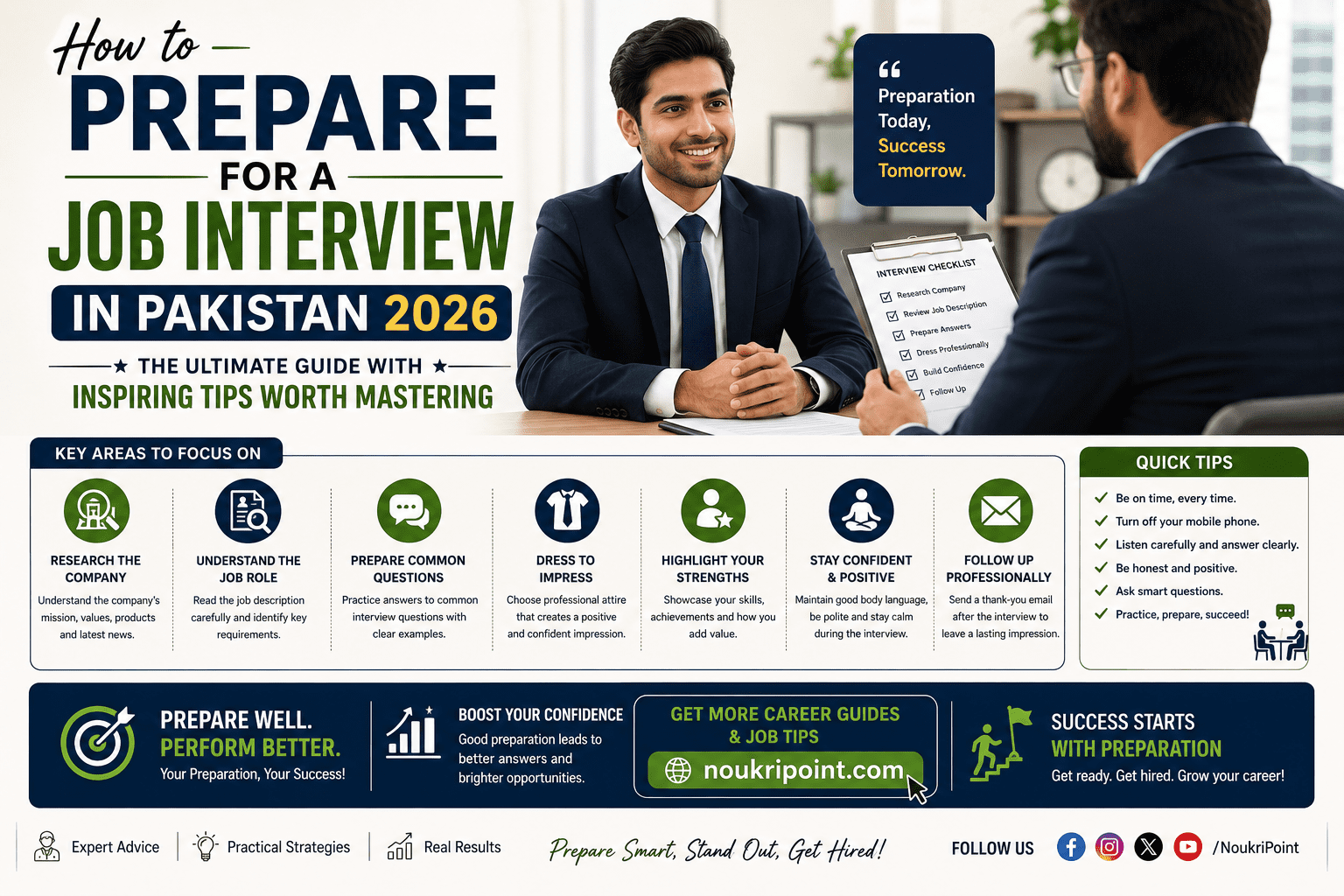
How to prepare for a job interview in Pakistan 2026 is a question that separates the candidates who walk out with offers from those who walk out wondering what went wrong. Getting to the interview is hard enough — the CV screening, the aptitude test, the recruiter call. By the time you are sitting across from a hiring panel at a company like Unilever, HBL, or the Civil Aviation Authority, you are already among the top 5% of applicants for that role. The interview is where that position is won or lost. This guide tells you precisely how to win it.
For more jobs visit : Noukri Point
Most candidates in Pakistan prepare for job interviews the wrong way. They memorise answers to a list of expected questions, rehearse until the answers sound scripted, and then freeze when the interviewer asks something slightly off-script. Real interview preparation is not about memorising — it is about building a bank of structured, credible stories from your own experience and learning how to retrieve the right one under pressure. That is the skill this guide will build in you.
How to Prepare for a Job Interview in Pakistan 2026 | Why Most Candidates Underperform
Pakistan’s job market in 2026 is more competitive than it has been at any previous point in the country’s private sector history. At multinational FMCG companies, banks, and tech firms, a single management trainee or associate-level vacancy routinely attracts thousands of applications. The candidates who reach the interview stage are, on paper, similarly qualified. What differentiates the hire from the runner-up is almost always interview performance — specifically, the ability to communicate clearly, connect experience to the role’s requirements, and project genuine confidence without crossing into arrogance.
Understanding how to prepare for a job interview in Pakistan 2026 starts with understanding the two types of interviews you are most likely to face: competency-based interviews used by multinationals and large corporates, and traditional interviews used by most mid-size Pakistani firms. Both reward preparation — but different kinds. This guide covers both.
Types of Job Interviews in Pakistan 2026 | Know What You Are Walking Into
Competency-Based Interviews
- Used by multinationals, large banks, FMCG companies, and telecoms in Pakistan
- Questions begin with “Tell me about a time when…” or “Give me an example of…”
- Answers are evaluated using the STAR framework — Situation, Task, Action, Result
- Interviewers score each answer against a competency rubric — leadership, analytical thinking, communication, resilience
- Preparation requires building a personal story bank of 8 to 10 real examples from your experience
Traditional Panel Interviews
- Most common at Pakistani mid-size companies, government institutions, and family-owned businesses
- Questions are more conversational — background, motivation, career goals, salary expectations
- Panel typically includes HR, line manager, and sometimes a senior director
- First impressions, confidence, and cultural fit carry more weight than in structured competency interviews
- Preparation focuses on company research, professional presentation, and clear career narrative
Online and Video Interviews
- Increasingly common as a first-round filter at Pakistani multinationals and tech firms in 2026
- Some use asynchronous video platforms where you record answers to pre-set questions with no interviewer present
- Lighting, background, microphone quality, and eye contact with the camera carry disproportionate weight
- Prepare your physical setup as carefully as your verbal answers — a dark or cluttered background undermines otherwise strong responses
| Interview Type | Common Employers | Key Preparation Focus |
|---|---|---|
| Competency-Based | Unilever, Nestle, HBL, Jazz, P&G | STAR story bank | 8–10 examples |
| Traditional Panel | Pakistani corporates, government, banks | Company research | career narrative | confidence |
| Video / Asynchronous | Tech firms, multinationals (first round) | Setup quality | concise answers | eye contact |
| Technical Interview | IT, Engineering, Finance firms | Domain knowledge | problem-solving | live tasks |
| Case Interview | Consulting, strategy roles | Structured thinking | frameworks | communication under pressure |
The STAR Method | How to Prepare for a Job Interview in Pakistan 2026 at a Multinational
The STAR method is the single most important framework for anyone preparing for a competency-based job interview in Pakistan 2026. Every major multinational operating in Pakistan — Nestle, Unilever, Reckitt, Shell, Engro, HBL, Standard Chartered — uses competency-based interviewing as its primary assessment tool. Candidates who understand and practise the STAR structure consistently outperform those who do not, even when their underlying experience is comparable.
Build your STAR story bank before the interview. Identify 8 to 10 real situations from your academic, internship, or work history that demonstrate the core competencies listed in the job description — leadership, problem solving, communication, initiative, resilience, teamwork, and analytical thinking. Write each story out in full. Practise delivering each one aloud until you can do so naturally in 90 seconds to 2 minutes without sounding rehearsed.
The STAR Answer That Gets Hired | A Real Pakistani Example Situation: “During my final semester at LUMS, our four-person project team lost a member two weeks before submission.” Task: “As team lead, I had to redistribute the work while maintaining the quality our client expected.” Action: “I mapped every remaining task, reassigned based on each member’s strongest skills, and negotiated a 48-hour extension with the client by presenting a revised delivery plan.” Result: “We submitted on time, received an A grade, and the client later offered two of us internships based on our professionalism during the crisis.” That is a STAR answer. It is specific, it is structured, it demonstrates leadership and problem-solving, and it ends with a result that is independently verifiable.
How to Prepare for a Job Interview in Pakistan 2026 | Step by Step
- Research the company thoroughly before the interview date Know the company’s products or services, its recent news, its key competitors, its stated values, and the specific role’s place within the organisational structure. In Pakistan, interviewers at companies like Packages, Daraz, or Faysal Bank regularly open with “What do you know about us?” — a question that eliminates underprepared candidates in the first two minutes. Spend at least one hour on company research for every interview you attend. Read their website, their LinkedIn page, and any recent press coverage.
- Prepare your answer to “Tell me about yourself” in advance This is the opening question in almost every Pakistani job interview regardless of the company or format. Use a three-part structure: your current role or most recent experience, your most relevant achievement, and why you are interested in this specific role at this specific company. Keep it to 90 seconds. Practise it out loud, not just in your head — the difference in delivery between spoken and mental rehearsal is significant.
- Prepare five STAR stories and practise them aloud Identify the five most common competencies tested for the role you are applying for — typically listed in the job description under “what we are looking for.” For each competency, prepare one real story from your experience that demonstrates it clearly using the Situation, Task, Action, Result structure. Practise each story aloud until you can deliver it in under two minutes without reading from notes.
- Prepare three intelligent questions to ask the interviewer Every Pakistani job interview ends with “Do you have any questions for us?” Candidates who say “No, I think everything was covered” signal low engagement and low curiosity. Prepare three questions that demonstrate you have researched the company and thought seriously about the role. Examples: “How does this team measure success in the first 90 days?” or “What does career progression typically look like for someone in this role?” Avoid questions about salary or leave policy in the first interview.
- Sort your logistics the night before — do not leave them for the morning Confirm the interview location and plan your route. If it is in-person, arrive 10 minutes early — not 30 minutes early (which creates awkwardness) and never late. Carry printed copies of your CV, your CNIC, and any certificates the advertisement mentioned. If it is a video interview, test your camera, microphone, internet connection, and lighting the evening before. Charging your laptop to 100% sounds obvious — it is overlooked more often than you would expect.
Practical Tips for How to Prepare for a Job Interview in Pakistan 2026
- Dress one level above the company’s standard dress code. If the company is business casual, dress business formal. If it is business formal, dress sharply formal. In Pakistan’s interview environment, being overdressed for an interview is almost never held against a candidate — being underdressed frequently is. When in doubt, choose the more formal option.
- Practise answering questions out loud, not just in your head. Mental rehearsal and spoken rehearsal produce entirely different results. The first time most candidates hear their own answers spoken aloud is in the interview itself — and it shows. Record yourself on your phone answering common questions. Watch it back. The gap between how you think you sound and how you actually sound is the gap between a good interview and a great one.
- Prepare a salary range before every interview, not after. Almost every Pakistani interview at some stage includes “What are your salary expectations?” Going in without a researched number puts you at an immediate disadvantage. Research the market rate for the role on LinkedIn, Indeed Pakistan, and by asking contacts in the industry. Give a range with your target at the lower end — for example, “I am looking at PKR 120,000 to PKR 140,000 based on my research and the scope of the role.”
- Follow up with a thank-you email within 24 hours of the interview. Very few Pakistani candidates send post-interview follow-up emails — which means doing so immediately distinguishes you. Keep it brief: thank the interviewer by name, reference one specific topic from the conversation, and restate your interest in the role. This takes five minutes and creates a positive impression that persists through deliberation.
- Do not badmouth your previous employer, ever. A question like “Why are you leaving your current job?” is a standard Pakistani interview question that functions as a character test. Candidates who answer with complaints about their previous employer — management style, colleagues, salary disputes — raise immediate red flags about their professionalism and discretion. Frame your answer around what you are moving toward, not what you are escaping from.
Frequently Asked Questions
What are the most common job interview questions in Pakistan 2026?
The most commonly asked questions include: Tell me about yourself, Why do you want to work here, What are your strengths and weaknesses, Where do you see yourself in five years, and Describe a challenge you overcame. Competency-based interviewers at multinationals add STAR-format questions such as “Give me an example of a time you managed a difficult deadline.” Prepare a structured answer for each of these before your interview date.
What should I wear to a job interview in Pakistan?
Men should wear a well-pressed formal shirt and trousers with clean leather shoes. A tie is recommended for banking, multinational, and senior-level interviews. Women should dress in formal business attire — a pressed shalwar kameez or formal western work wear in neutral tones. Avoid strong fragrances, casual footwear, and excessive accessories regardless of the industry or company culture. When in doubt, dress more formally than you think necessary.
How do I answer “Tell me about yourself” in a Pakistani job interview?
Use a three-part structure: your current or most recent role, your most relevant achievement or qualification, and why you are specifically interested in this role. Keep the answer to 90 seconds. Do not begin with your hometown or family background. Begin with your professional identity and move directly to why you are the right person for the role in front of you.
What is the STAR method and how do I use it in Pakistani job interviews?
STAR stands for Situation, Task, Action, Result. It is the standard answer framework for competency-based interviews at multinationals and large Pakistani corporates. When asked a behavioural question, describe the context (Situation), your responsibility (Task), what you specifically did (Action), and the measurable outcome (Result). Each STAR answer should take 90 seconds to 2 minutes. Build a bank of 8 to 10 STAR stories before your interview and practise them aloud.