
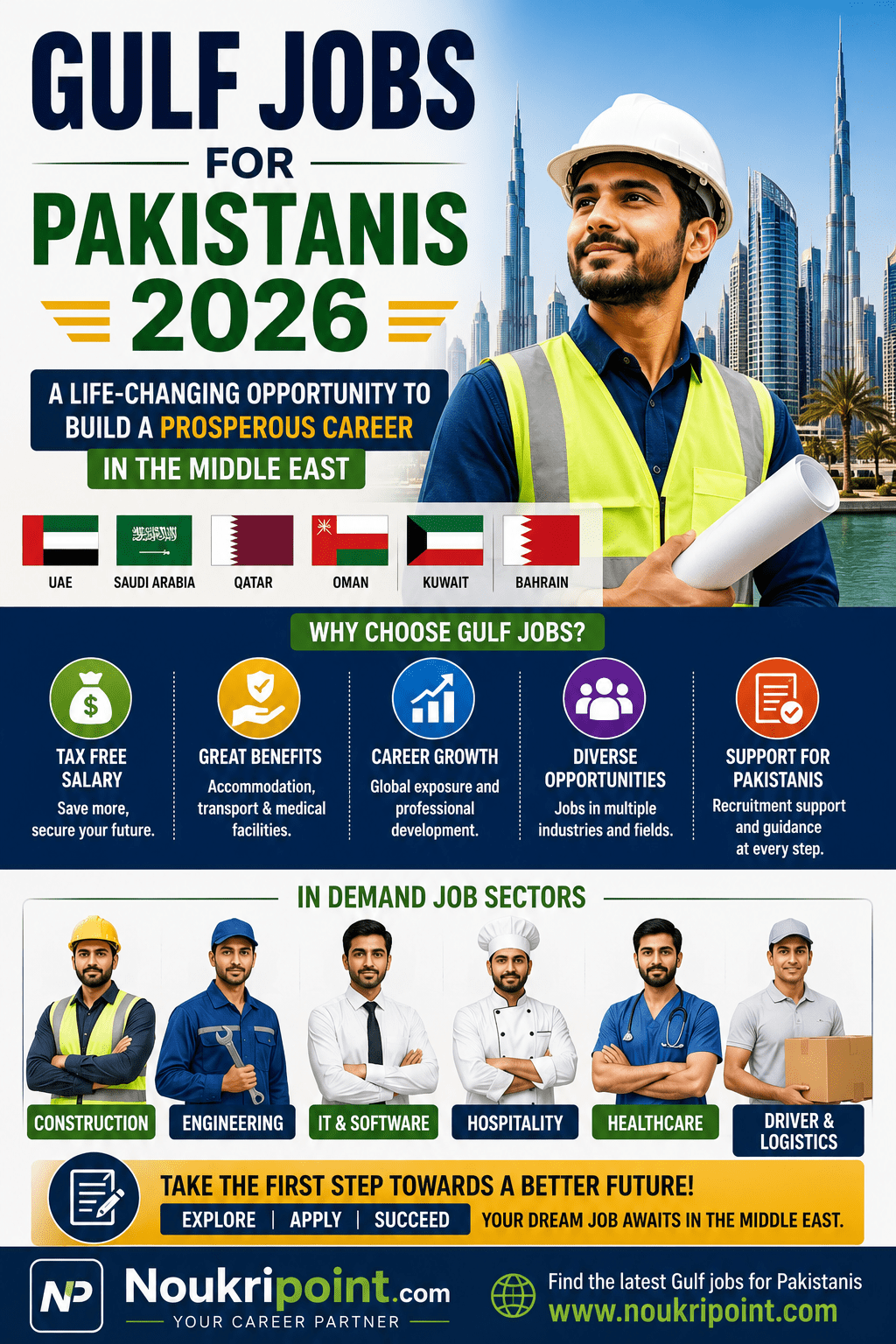
Gulf Jobs for Pakistanis 2026 continue to represent the single largest overseas employment opportunity available to Pakistani workers and professionals — a market that sends over 800,000 Pakistanis abroad every year and generates remittances that are the backbone of the country’s foreign exchange earnings. The Gulf Cooperation Council countries — UAE, Saudi Arabia, Qatar, Kuwait, Bahrain, and Oman — are actively recruiting Pakistani talent across an enormous range of sectors in 2026, from skilled construction and manufacturing trades to engineering, healthcare, IT, and financial services. Whether you are a fresh graduate seeking your first professional role abroad or an experienced professional looking to double your earnings, the Gulf in 2026 has a vacancy for your profile. This guide tells you exactly where to look, what to expect, and how to navigate the process from Lahore or Karachi all the way to your first day in Dubai or Riyadh.
For more jobs visit : Noukri Point
I want to be direct about the scale of what we are discussing. Pakistan’s Bureau of Emigration records consistently show that the Gulf accounts for 85 to 90 percent of all documented overseas employment departures from Pakistan in any given year. The UAE and Saudi Arabia alone absorb more Pakistani workers annually than all other international destinations combined. This is not a niche employment channel — it is the largest single component of Pakistan’s labor export economy, and in 2026 it remains as active and in-demand as ever, particularly given Vision 2030 construction activity in Saudi Arabia and the UAE’s post-Expo 2020 infrastructure expansion.
Why Gulf Jobs for Pakistanis 2026 Remain the Most Impactful Career Move Available
The fundamental economic case for Gulf employment has not changed — it has strengthened. With the Pakistani rupee having depreciated significantly over the past three years, the effective PKR value of Gulf salaries has increased substantially for workers sending remittances home. A Pakistani engineer earning AED 12,000 per month in Dubai in 2026 is remitting an amount in rupee terms that would have required a dramatically higher AED salary just five years ago. This currency differential is a structural advantage that makes Gulf employment uniquely powerful for Pakistani families building long-term financial stability.
Beyond the currency factor, the Gulf in 2026 is undergoing genuine economic transformation. Saudi Arabia’s Vision 2030 program is the largest government-funded economic diversification effort in the region’s history, generating demand for engineers, project managers, healthcare workers, educators, and hospitality professionals at a scale that cannot be met by the domestic Saudi workforce alone. Qatar continues expanding its LNG and infrastructure capacity post-FIFA World Cup. The UAE has expanded its Golden Visa program, created new free zone structures, and attracted a wave of international companies establishing regional headquarters — all of which create sustained demand for professional talent.
Gulf Jobs for Pakistanis 2026 | Top Sectors and In-Demand Roles
Construction and Civil Engineering
Saudi Arabia’s Vision 2030 megaprojects — NEOM, The Line, Qiddiya, Red Sea Project — are generating sustained, multi-year demand for Pakistani civil engineers, quantity surveyors, site supervisors, and skilled construction tradespeople. The UAE also continues large-scale infrastructure development across Dubai and Abu Dhabi. In-demand roles include:
- Civil / Structural Engineer (BE Civil with 3 to 10 years experience)
- Quantity Surveyor and Cost Estimator
- Site Supervisor and Foreman (skilled trades with 5+ years experience)
- MEP (Mechanical, Electrical, Plumbing) Engineer and Technician
- Safety Officer (NEBOSH / IOSH certified preferred)
Oil, Gas, and Petrochemicals
- Process / Chemical Engineer for Saudi Aramco, ADNOC, QatarEnergy, and contractor companies
- Petroleum and Reservoir Engineer
- Instrumentation and Control Engineer
- HSE (Health, Safety, Environment) Specialist
- Pipeline Technician and Maintenance Engineer
Healthcare
All six GCC countries face chronic healthcare workforce shortages and actively recruit Pakistani doctors, nurses, pharmacists, and paramedics under bilateral government agreements. DHA (Dubai Health Authority) and HAAD (Abu Dhabi Health Authority) licensing is required for UAE placements; SCFHS registration is required for Saudi Arabia.
- MBBS and specialist doctors — particularly Internal Medicine, General Surgery, Obstetrics, Paediatrics
- Registered Nurses (BSN preferred) for hospitals and clinics
- Pharmacist (PharmD with active PMDC/PPC registration)
- Radiologist and Sonographer
- Medical Lab Technologist
Information Technology
- Software Developer (React, Node.js, Python, Java — 2 to 8 years experience)
- Cloud Engineer (AWS / Azure / GCP certified)
- Cybersecurity Analyst
- Data Analyst and Business Intelligence Specialist
- IT Project Manager (PMP certification valued)
Accounting, Finance, and Banking
- Accountant and Senior Accountant (CA / ACCA / CPA preferred)
- Internal Auditor
- Financial Analyst
- Banking Officer and Relationship Manager for UAE and Qatar retail banks
| Gulf Country | Top Sectors for Pakistanis | Approximate Monthly Salary (PKR Equivalent) |
|---|---|---|
| UAE (Dubai / Abu Dhabi) | IT, Finance, Construction, Healthcare, Hospitality | PKR 620,000 to PKR 1,950,000 (AED 8K to 25K) |
| Saudi Arabia | Oil & Gas, Construction, Healthcare, Education | PKR 460,000 to PKR 1,540,000 (SAR 6K to 20K) |
| Qatar | LNG, Construction, Hospitality, IT | PKR 430,000 to PKR 1,350,000 (QAR 5K to 16K) |
| Kuwait | Oil & Gas, Engineering, Healthcare | PKR 390,000 to PKR 1,100,000 (KWD 400 to 1,100) |
| Oman | Construction, Logistics, Manufacturing | PKR 200,000 to PKR 600,000 (OMR 500 to 1,500) |
OEC, BEOE, and the Official Pakistan Emigration Framework
Before any documented overseas departure, Pakistani workers must obtain an Overseas Employment Certificate (OEC) from the Bureau of Emigration and Overseas Employment (BEOE). This is a non-negotiable legal requirement — departing without an OEC means your employment is undocumented, which strips you of legal protections abroad and creates complications at the airport. Here is what you need to know:
- OEC applications are submitted at official site or through any BEOE regional office across Pakistan
- You need a confirmed employment offer letter, valid work visa, valid passport, and CNIC to apply
- The OEC is issued within 1 to 3 working days for standard applications — longer for first-time emigrants who need additional documentation
- For blue-collar and trade workers, use OEC-registered recruitment agencies only — the BEOE maintains a public list of licensed agencies on its website
- The Overseas Employment Corporation (OEC) at oficial site is Pakistan’s government recruitment body and directly channels workers to vetted Gulf employers through government-to-government agreements
⚠ Protect Yourself: How to Identify Fraudulent Gulf Job Offers Gulf job fraud is a persistent and serious problem that destroys families financially every year. Protect yourself by following these non-negotiable rules: Never pay a placement fee exceeding one month’s salary — legitimate licensed agencies charge regulated fees, not large upfront sums. Never travel on a visit visa expecting to convert it to a work visa upon arrival — this practice is now illegal in most GCC countries and leaves workers stranded without legal status. Always verify your prospective employer’s commercial registration through the destination country’s official business registry before signing a contract. If a Gulf job offer sounds significantly better than market rates for your qualification level, it warrants verification before commitment. Check the BEOE’s list of licensed Pakistani recruitment agencies at beoe.gov.pk and only use agencies on that list.
How to Apply for Gulf Jobs for Pakistanis 2026: Step by Step
- Identify your target country and sector clearly before starting Gulf job searching without a defined target is the single most common reason candidates waste months applying to mismatched roles. Decide your target country and sector based on your specific qualification, experience level, language ability, and salary expectation — then search within that defined space rather than applying broadly across all six GCC countries for every vacancy you encounter.
- Build a Gulf-format CV Gulf employers — particularly in the UAE and Saudi Arabia — expect CVs formatted differently from Pakistani norms. Include a professional photo, full date of birth, nationality, visa status, and a one-paragraph professional summary at the top. Keep the document to two pages maximum. Remove the long lists of references that Pakistani CVs typically include — a line stating “References available on request” is sufficient.
- Apply through verified platforms for professional roles For white-collar and professional Gulf jobs, the most reliable platforms in 2026 are official sites LinkedIn, and the direct careers pages of major Gulf employers (Aramco, ADNOC, QatarEnergy, Emaar, DEWA, Etihad, Emirates). For trade and semi-skilled roles, apply through the OEC at official site or through a BEOE-licensed recruitment agency.
- Get your credentials attested and equivalency verified Gulf employers require HEC-attested educational certificates for all professional roles. For healthcare workers, PEC-registered engineers, and licensed professionals, additional credential equivalency verification is required by the destination country’s licensing authority — DHA or HAAD for the UAE, Saudi Commission for Health Specialties (SCFHS) for Saudi Arabia. Begin this process 8 to 12 weeks before your expected departure — it takes longer than most candidates anticipate.
- Complete the GAMCA medical fitness examination All Gulf-bound Pakistani workers must pass a medical fitness examination at a GAMCA (Gulf Approved Medical Centers Association) accredited clinic in Pakistan. GAMCA clinics are located in all major Pakistani cities. The medical includes blood tests, chest X-ray, and fitness assessment. A positive result — fit for employment — is a prerequisite for visa issuance. Schedule the medical only after receiving your formal job offer and employment visa documentation from your Gulf employer.
- Obtain your OEC and complete departure registration With your offer letter, work visa, attested credentials, GAMCA medical clearance, and valid passport in hand, submit your OEC application at official site or the nearest BEOE regional office. Once issued, your overseas departure is documented and you have legal protection under Pakistan’s emigration framework. Retain a physical copy of your OEC — it is checked at the airport departure gate.
Practical Tips to Maximize Your Gulf Job Search in 2026
- LinkedIn optimization is no longer optional for professional Gulf roles. The majority of professional Gulf employers in 2026 screen candidates on LinkedIn before reviewing submitted CVs. Your LinkedIn profile must include a professional headshot, a detailed work history with quantified achievements, skill endorsements, and recommendations from managers or senior colleagues. An incomplete or outdated LinkedIn profile actively harms your application even when your CV is strong.
- For Saudi Arabia, Arabization is creating new opportunities for bilingual Pakistani professionals. Vision 2030’s Saudization (Nitaqat) program is simultaneously creating demand for non-Saudi professionals in sectors and levels that Saudi nationals are not yet qualified to fill at scale. Pakistani professionals who speak Arabic — even at a conversational level — command a significant hiring premium over equally qualified English-only candidates in the Saudi market. If you have any Arabic exposure, list it prominently.
- UAE Golden Visa holders have a structural advantage in the Dubai job market. Pakistan’s growing community of UAE Golden Visa holders — awarded to investors, professionals, and researchers — can work and job-search in the UAE without employer visa dependency. If you qualify for the Golden Visa through existing UAE savings or a qualifying professional profile, securing it before your job search removes the timeline pressure that employer-sponsored visa arrangements create.
- Engineering PEC registration abroad is increasingly required, not just recommended. Several Gulf engineering employers — particularly in Saudi Arabia and Qatar — now require foreign engineers to have their professional credentials recognized by the Saudi Council of Engineers or Qatar’s engineering registration authority before receiving a conditional offer. Begin this process in parallel with your job search, not after receiving an offer, as it can take 6 to 10 weeks.
- Reach out to Pakistani community networks in your target Gulf city before you arrive. Pakistani professional associations in Dubai (Pakistan Business Council Dubai), Riyadh, and Doha maintain active WhatsApp and LinkedIn groups where job openings are shared informally before they are advertised publicly. These networks also provide realistic, current salary data that helps you negotiate confidently when an offer arrives.
Frequently Asked Questions
Which Gulf country pays Pakistani workers the most in 2026?
The UAE — particularly Dubai and Abu Dhabi — offers the highest absolute salaries for Pakistani professionals in 2026, with professional-level roles earning AED 8,000 to AED 25,000 per month (approximately PKR 620,000 to PKR 1,950,000 at current exchange rates). Kuwait offers competitive compensation for oil and engineering sector roles. Saudi Arabia offers strong packages for healthcare and Vision 2030 project roles, though personal income tax-free status applies across all GCC countries.
What documents are required for Gulf jobs for Pakistanis?
Required documents include: valid passport (6+ months validity), CNIC, HEC-attested educational certificates, experience letters, police character certificate, GAMCA medical fitness clearance, and an OEC from the Bureau of Emigration. Professional license holders (doctors, engineers, nurses) also need credential equivalency recognition from the destination country’s licensing authority before or shortly after arrival.
Is Gulf employment safe for Pakistani workers in 2026?
Documented Gulf employment through licensed channels — OEC-registered agencies, direct employer applications, and government-to-government OEC schemes — is safe and legally protected. Risks arise from undocumented travel, visit visa misuse, and unlicensed recruitment agencies. Always verify your recruitment agency’s license status on the BEOE website, never pay excessive upfront fees, and ensure your OEC is obtained before departure. Pakistan’s embassies and consulates in all GCC countries also provide labor protection services for documented overseas workers.