
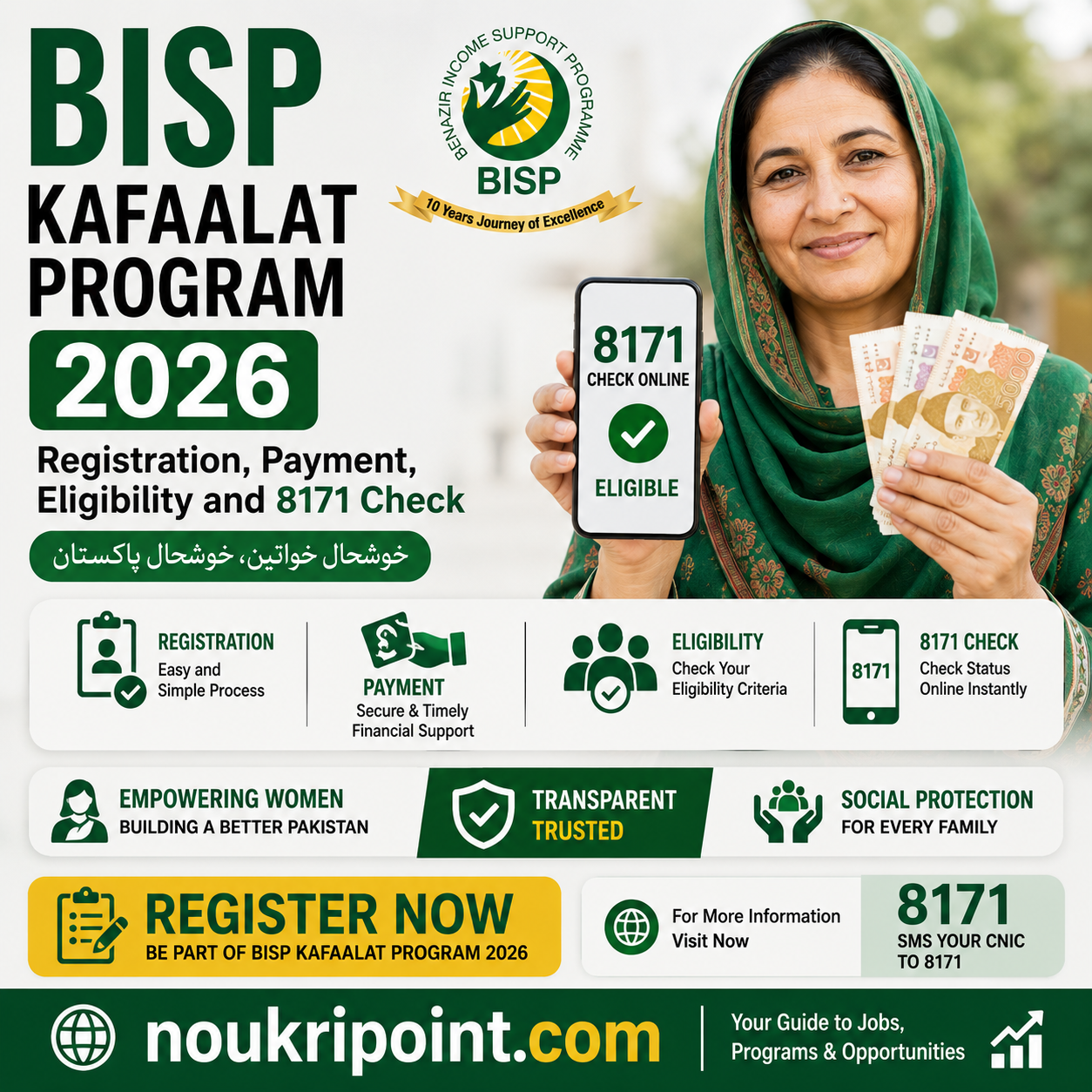
BISP Kafaalat Program 2026 provides a quarterly cash stipend of PKR 10,500 to eligible female heads of low-income households across Pakistan, verified through the National Socio-Economic Registry (NSER) Poverty Means Testing (PMT) survey. Eligibility is checked by sending your 13-digit CNIC number via SMS to 8171 or visiting bisp.gov.pk. New registrations are processed at BISP Tehsil Offices nationwide — registration is entirely free. Payments are disbursed through the BISP Smart Card (Kafalat Card), HBL bank branches, Pakistan Post payment counters, and licensed retailer payment points. BISP never charges any fee for registration or payment — any person demanding money for BISP registration or payment collection is committing fraud and should be reported immediately.
For more jobs visit : Noukri Point
For Pakistan’s poorest households, the BISP Kafaalat stipend is not simply a government transfer — it is a lifeline that funds food, medicine, children’s school supplies, and basic utilities for families with no other formal income source. Since its launch in 2008, BISP has grown into the country’s primary social safety net, and Kafaalat remains its flagship unconditional cash transfer programme targeting women as the primary beneficiary to promote female financial inclusion and household welfare decision-making.
BISP Kafaalat Program 2026 | Key Details at a Glance
| Detail | Information |
|---|---|
| Programme Name | BISP Kafaalat (Benazir Income Support Programme — Kafaalat) |
| Administering Authority | Benazir Income Support Programme (BISP), Government of Pakistan |
| Payment Amount | PKR 10,500 per quarter (PKR 3,500/month effective) |
| Payment Frequency | Quarterly (every 3 months) |
| Beneficiary | Registered female head of eligible low-income household |
| Eligibility Basis | NSER PMT score below national poverty threshold |
| 8171 SMS Check | Send 13-digit CNIC to 8171 on any Pakistani network |
| Payment Methods | BISP Smart Card, HBL branches, Pakistan Post, Retailer Points |
| Registration | BISP Tehsil Offices | NSER survey camps | Free of charge |
| Official Website | bisp.gov.pk |
| Helpline | 0800-26477 (0800-BISP77) — toll-free |
Eligibility Criteria | BISP Kafaalat Program 2026
Who Qualifies for BISP Kafaalat?
Eligibility for BISP Kafaalat is not self-declared — it is determined objectively by the National Socio-Economic Registry (NSER), which collects household-level data through field surveys conducted by BISP-trained data collectors across Pakistan. The NSER calculates a Poverty Means Testing (PMT) score for each surveyed household based on multiple socio-economic indicators. Households with a PMT score below the government-set national poverty threshold are automatically enrolled as eligible Kafaalat beneficiaries.
Eligibility Conditions
- The household must have completed the NSER survey and hold a PMT score below the national poverty threshold
- The registered beneficiary must be a female Pakistani national with a valid, non-expired CNIC
- No member of the household must be a government employee at federal, provincial, or local level
- The household must not own taxable agricultural land above BISP-defined limits
- The household must not own a registered motorized vehicle (except motorcycles in rural areas under specific thresholds)
- Household income must not exceed BISP’s defined income threshold
- The household must not have a member filing income tax returns
Priority Groups
While all households meeting the PMT threshold qualify, the following categories receive priority processing and additional consideration within the Kafaalat framework:
- Widows: Women whose husbands are deceased and who are the sole income earner or dependent
- Divorced women: Female-headed households following legal or customary divorce
- Women with disabled husbands: Households where the male head is permanently disabled and unable to work
- Women without CNICs: Previously ineligible women can now obtain CNIC through NADRA facilitation at BISP offices, enabling registration
- Transgender women: Registered transgender women with CNIC are eligible to apply as female beneficiaries
- Flood and disaster-affected households: Emergency BISP enrolment may apply during declared natural disaster periods
Disqualification Conditions
The following conditions disqualify a household from BISP Kafaalat, even if the PMT score would otherwise qualify:
- Any household member holding a federal or provincial government job
- Ownership of a registered car, truck, or heavy vehicle
- Ownership of taxable commercial property in urban areas
- Active income tax filer status for any household member
- Receipt of another federal government cash transfer in the same category
How to Check BISP Kafaalat Eligibility via 8171
The fastest and most widely used method to verify BISP Kafaalat eligibility or payment status in 2026 is the 8171 SMS service. The process is straightforward:
- Open SMS on any Pakistani mobile network The 8171 service works on all major Pakistani mobile networks including Jazz, Telenor, Ufone, Zong, and SCOM. No internet connection is required — standard SMS charges apply as per your network tariff.
- Type your 13-digit CNIC number (without dashes) Enter your complete 13-digit Pakistani CNIC number as the SMS message body. Do not include dashes or spaces — type all 13 digits consecutively. Example: if your CNIC is 35201-1234567-8, type 3520112345678 as the SMS text.
- Send the SMS to 8171 Send the SMS message containing your 13-digit CNIC number to the short code 8171. You will receive an automated reply within a few minutes (usually under 5 minutes on most networks).
- Read the automated response The 8171 reply will indicate one of the following: (a) you are a registered BISP Kafaalat beneficiary and your payment status for the current quarter; (b) you are not registered — visit your nearest BISP office to apply for NSER survey; or (c) your CNIC is expired — renew at NADRA to restore payment eligibility. Save the reply SMS for reference when visiting a payment point.
Alternatively, beneficiaries can check status online at bisp.gov.pk using the CNIC-based beneficiary lookup tool on the official portal. In-person verification is also available at any BISP Tehsil Office by presenting your original CNIC.
How to Register for BISP Kafaalat Program 2026
If the 8171 check returns a “not registered” response, your household has not yet been surveyed under the NSER or may not have qualified in a previous survey cycle. You can apply for a new NSER survey by visiting your nearest BISP Tehsil Office. BISP also periodically conducts mobile NSER survey camps in rural and peri-urban areas — announcements for these camps are made through local government offices, mosques, and BISP social media channels.
- Locate your nearest BISP Tehsil Office BISP operates Tehsil Offices in all districts across Pakistan. You can find your nearest office by calling the toll-free helpline at 0800-26477 or by checking the office locator on bisp.gov.pk. Bring your original CNIC — no appointment is required for walk-in visits during working hours (Monday to Friday, 8:00 AM to 4:00 PM).
- Request an NSER survey registration At the Tehsil Office, inform the staff that you wish to apply for NSER survey registration. Provide your 13-digit CNIC number. Staff will record your household’s basic information and either conduct the PMT survey on-site or schedule a home visit by a BISP data collector, depending on the office’s current workload and survey cycle status in your area.
- Complete the NSER household survey A BISP data collector will survey your household’s socio-economic conditions, including: housing type (kuccha/puccha), number of rooms, ownership of household assets (TV, refrigerator, motorcycle), agricultural landholding, number of household members, education levels, and income sources. Answer all questions honestly — false declarations can result in disqualification and legal action. The survey typically takes 20 to 40 minutes.
- Await PMT score calculation and enrolment notification After survey completion, your data is submitted to BISP’s central processing system. PMT score calculation takes several weeks. Once processed, you will receive an SMS notification at the mobile number registered with your CNIC. If your score qualifies, you will receive instructions for biometric verification and Smart Card issuance. Send your CNIC to 8171 periodically to track your registration status.
- Complete biometric verification and collect your Smart Card Eligible beneficiaries are called to a BISP payment point or Tehsil Office for biometric thumbprint verification linked to their CNIC. Upon successful biometric verification, the BISP Smart Card (Kafalat Card) is issued. This card is used to withdraw quarterly Kafaalat payments at designated ATMs, HBL branches, and retailer payment points. Keep your Smart Card safe — replacements require a formal application at the Tehsil Office.
How to Collect BISP Kafaalat Payment in 2026
Payment Methods Available
BISP Kafaalat payments for 2026 are disbursed through multiple channels to reach beneficiaries in both urban and remote rural areas:
- BISP Smart Card (Kafalat Card): Used at HBL ATMs, HBL branches, and BISP-designated retailer payment points. The card is linked to the beneficiary’s biometric data — withdrawal requires thumbprint verification at the payment terminal. This is the primary payment method for most beneficiaries.
- HBL Bank Branches: Beneficiaries enrolled through the banking channel can collect payments at designated HBL branches by presenting their original CNIC and completing thumbprint biometric verification at the branch counter.
- Pakistan Post Payment Centers: In areas where HBL access is limited, designated Pakistan Post offices serve as BISP payment distribution points, particularly in rural Punjab, KPK, Balochistan, and remote AJK areas.
- Retailer Payment Points (RPPs): BISP has contracted with thousands of local shopkeepers and franchisees equipped with biometric payment devices to serve as last-mile payment points in areas without bank branches. Beneficiaries can withdraw from any RPP in their district using their Smart Card.
Payment Schedule 2026
BISP Kafaalat payments are disbursed on a quarterly basis. BISP announces each quarterly payment period through its official website, national media, and SMS notifications to beneficiaries. Beneficiaries typically have a window of several weeks within each quarter to collect their payment — uncollected payments are held and remain available in the following cycle but beneficiaries should collect promptly to avoid complications.
What to Bring When Collecting Payment
- Original CNIC (non-expired) — expired CNIC results in payment suspension
- BISP Smart Card (Kafalat Card) if issued
- The beneficiary herself must be physically present — payments cannot be collected by a proxy or family member on her behalf
- Mobile phone used for SMS verification (at some payment points)
Frequently Asked Questions | BISP Kafaalat Program 2026
How do I check my BISP Kafaalat eligibility in 2026?
Send your 13-digit CNIC number (without dashes) via SMS to 8171 from any Pakistani mobile network. You will receive an automated reply indicating your registration and payment status. You can also check at bisp.gov.pk or visit your nearest BISP Tehsil Office with your original CNIC. If the 8171 response says you are not registered, visit your BISP office to request a fresh NSER survey.
What is the BISP Kafaalat payment amount in 2026?
The BISP Kafaalat payment in 2026 is PKR 10,500 per quarter, disbursed every three months. This works out to an effective PKR 3,500 per month. Payments are made directly to the registered female beneficiary through the BISP Smart Card, HBL branches, Pakistan Post, or retailer payment points. Always verify the current amount via 8171 or bisp.gov.pk as BISP periodically revises payment amounts.
Is BISP Kafaalat registration free?
Yes. BISP Kafaalat registration is entirely free. BISP does not charge any fee for NSER survey registration, Smart Card issuance, or payment collection. Any person demanding money to register you for BISP, process your application, or collect your payment on your behalf is committing fraud. Report such individuals to the BISP toll-free helpline at 0800-26477 or the local police.
My CNIC expired — will my BISP payment stop?
Yes. An expired CNIC will result in suspension of your BISP Kafaalat payments. You must renew your CNIC through NADRA as quickly as possible. NADRA operates facilitation desks at many BISP Tehsil Offices to assist beneficiaries with CNIC renewal. Once your new CNIC is issued and updated in the BISP system, your payments will be restored. Unpaid instalments during the suspension period may or may not be recovered — contact your BISP Tehsil Office for guidance on your specific case.
Can men apply for BISP Kafaalat?
No. BISP Kafaalat is exclusively for female beneficiaries. The registered beneficiary must be the female head of household or designated female representative of the eligible household with a valid female CNIC. This design is intentional — placing cash in women’s hands is proven to increase household welfare spending on food, children’s education, and healthcare. However, male family members may assist women in locating payment points or navigating the registration process, but cannot register in their own name or collect payments on behalf of a female beneficiary.